
PV-Calor | Making Building Energy Technology Calculable
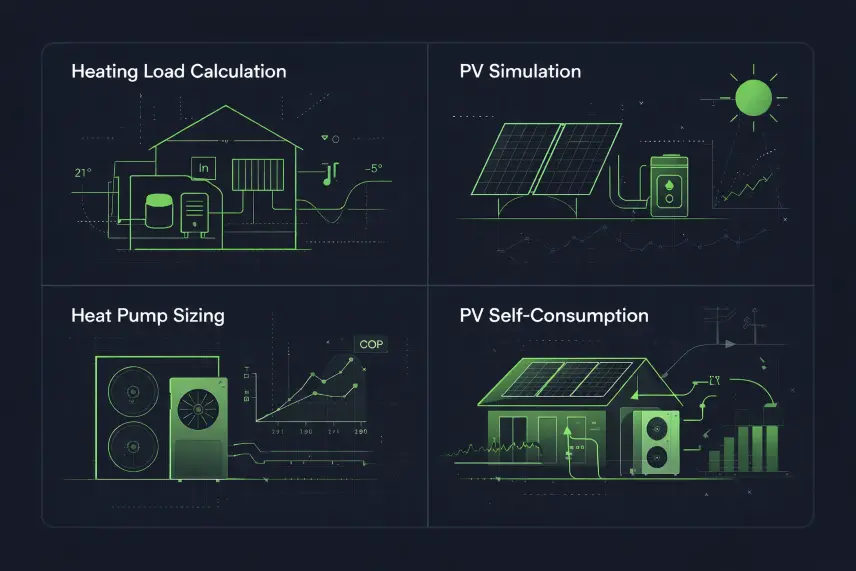
The energy transition in buildings starts with proper planning. When you want to size a photovoltaic system, determine your house's heating load, or design a heat pump, you face a multitude of technical questions. That's exactly where PV-Calor comes in.
We've brought together the most important calculation tools for building energy technology on one platform. All calculators are based on current standards such as DIN EN 12831, VDI 4650, or climate data from PVGis. This means: you get results you can rely on – without having to struggle through different tools and data sources.
And here's the best part: The calculators work hand in hand. Once you've completed a heating load calculation, you can transfer the values directly to the heat pump calculator. Conversely, your heat pump's electricity consumption – with an hourly load profile specific to your location – can be fed into the solar calculator as a consumer. This creates a coherent overall concept where all components are properly coordinated.
Why PV-Calor?
The name combines the two core areas of modern building energy technology: PV stands for photovoltaics, the generation of electricity from sunlight. Calor – derived from the Latin word for heat – represents the thermal aspect: heating load, heat demand, heat pumps.
But Calor has an additional meaning for us. It reminds us of the calorie, that unit of energy that has been used to measure thermal energy for centuries. And if you listen closely: Calor sounds like Calculator. Because that's exactly what we offer – precise calculators that help you plan based on solid foundations.
With PV-Calor, you have everything in one place: heating load calculation, heat demand assessment, photovoltaic planning, and heat pump design. Our goal is to make the complex world of building energy technology transparent. For professional planners, installers, and builders who want to know what's really involved in their project.
Available Calculators
Standard heating load according to DIN EN 12831-1 and annual heat demand. Find out how much heating power you really need – room by room.
Calculate heating load now →Sizing PV systems with PVGis climate data. Self-consumption optimization, storage design and economic analysis.
To calculator →Seasonal performance factor (SPF) according to VDI 4650 and heat pump design. Find out if a heat pump makes sense for your building.
To calculator →SCOP and SEER for split air conditioners according to EN 14825. Calculate efficiency and operating costs for heating and cooling.
To calculator →Knowledge
Deepen your knowledge of photovoltaics, heat pumps, heating load and building energy.
Note: The knowledge articles are currently only available in German.

Fundamentals, structure and key figures of photovoltaic systems explained clearly.

Battery technologies, system topologies and market trends for solar systems explained clearly.

Heat pump basics, types, performance indicators and the ideal combination with photovoltaics.

Heating load and heat demand calculation according to DIN EN 12831, U-values, annual heat demand, thermal bridges and renovation measures.

Powerstations and compact storage for balcony solar systems – the straightforward entry into home power generation.

From kW to COP, from efficiency to SPF – the reference guide for technical metrics.
Heating Load Calculation: How Much Heat Does Your Building Need?
The heating load is the key parameter for any heating system design. It describes how much thermal power your building requires to maintain a comfortable indoor temperature at the coldest expected outdoor temperature. Without this figure, a proper sizing of heat generators and radiators is simply not possible.
Our heating load calculator performs a complete calculation according to DIN EN 12831-1 – the European standard that is also mandatory for funding programmes and energy certificates. You capture your building room by room: component areas, U-values, ventilation concept. The calculator automatically determines the design outdoor temperature for your location and accounts for correction factors for ground contact, unheated spaces and thermal bridges.
The result is not an abstract number, but a practical planning basis: You learn the heating load of each individual room and can derive the appropriate radiator size from it. The building heating load shows which heat pump or boiler is suitable for your house. And the calculated annual heat demand gives you an idea of the expected heating costs.
Solar Calculator: Plan Photovoltaics for Your Roof
A photovoltaic system produces electricity exactly when the sun is shining – but your household consumes power around the clock. This interplay between generation and consumption largely determines the economic viability of a system. Our solar calculator makes these complex relationships visible and calculable.
At the heart of the calculator are the climate data from PVGis (Photovoltaic Geographical Information System), the official database of the European Commission. For your exact location, hourly irradiance values over a typical year are taken into account – including roof inclination, orientation and local shading. This gives you a realistic forecast of the annual yield in kilowatt-hours.
But the calculator goes further: It simulates your self-consumption share based on your load profile. You can see how much of your solar power you can use yourself and how much flows into the grid. Optionally, you can add a battery storage system and analyse its effect on self-sufficiency and profitability. The integrated economic calculation shows payback period, return on investment and total savings over the system's lifetime.
Heat Pump Calculator: Efficient Heating with Environmental Energy
A heat pump uses free environmental heat from air, ground or groundwater and makes it usable for heating. But not every building is equally well suited for a heat pump. The crucial question is: How efficiently will the heat pump operate in your specific case?
The answer is provided by the Seasonal Performance Factor (SPF) – the ratio of heat generated to electricity consumed over an entire year. Our heat pump calculator determines the SPF according to VDI 4650, the recognised calculation method for heat pump efficiency. It takes all relevant factors into account: flow temperature of your heating system, chosen heat source, domestic hot water preparation and the climate conditions at your location.
If you have already performed a heating load calculation, you can transfer the values directly. This creates a coherent overall picture: You see what heat pump capacity you need, how high the annual electricity consumption will be and whether the investment pays off for your building. The calculator also shows how a lower flow temperature – for example through underfloor heating – affects efficiency.
Air-to-Air Heat Pump Calculator: Split Air Conditioners for Heating and Cooling
Split air conditioners don't just cool – modern units are fully-fledged air-to-air heat pumps that heat efficiently in winter. But how efficiently does such a system operate over the entire year? And is it worthwhile as a primary or supplementary heating system?
Our air-to-air heat pump calculator determines the SCOP (heating) and SEER (cooling) according to EN 14825 – the European metrics for seasonal efficiency. You get a realistic estimate of electricity consumption in both heating and cooling modes. The calculator takes your climate zone (Average, Warmer, Colder) and actual temperature conditions throughout the year into account.
Particularly interesting: The calculator also simulates bivalent operation, where the split air conditioner supplements an existing gas heating system. You see up to which outdoor temperature the heat pump operates economically and how the combination affects your heating costs. For multi-split systems, you can combine multiple indoor units and determine overall efficiency.
More information and guides can be found in the Guides section (German).
Note: All calculations are based on German and European standards (DIN, VDI, EN). The calculators are designed for Europe and use climate data from the PVGis database.