
Free Building Energy Calculators
Professional online tools for calculating heating load, heat pump efficiency, air-to-air heat pumps, and solar system yield – free and according to German and European standards.
Our Calculators Overview

Calculate your building's heating load according to DIN EN 12831-1
The heating load calculator determines the required thermal power for your building in compliance with standards. This allows you to precisely size boilers, heat pumps, and radiators.
What the calculator offers:
- Room-by-room heating load calculation per DIN EN 12831-1
- Standard heating load and annual heat demand
- Comprehensive U-value catalog for building components
- Consideration of thermal bridges and ventilation heat losses
- Radiator sizing (underfloor heating and radiators)
- Renovation recommendations with savings potential
- PDF export with detailed documentation
Suitable for:
- Homeowners planning heating renovation
- Planners and energy consultants
- Heating contractors for quote preparation
- Heat pump interested parties
Further information:
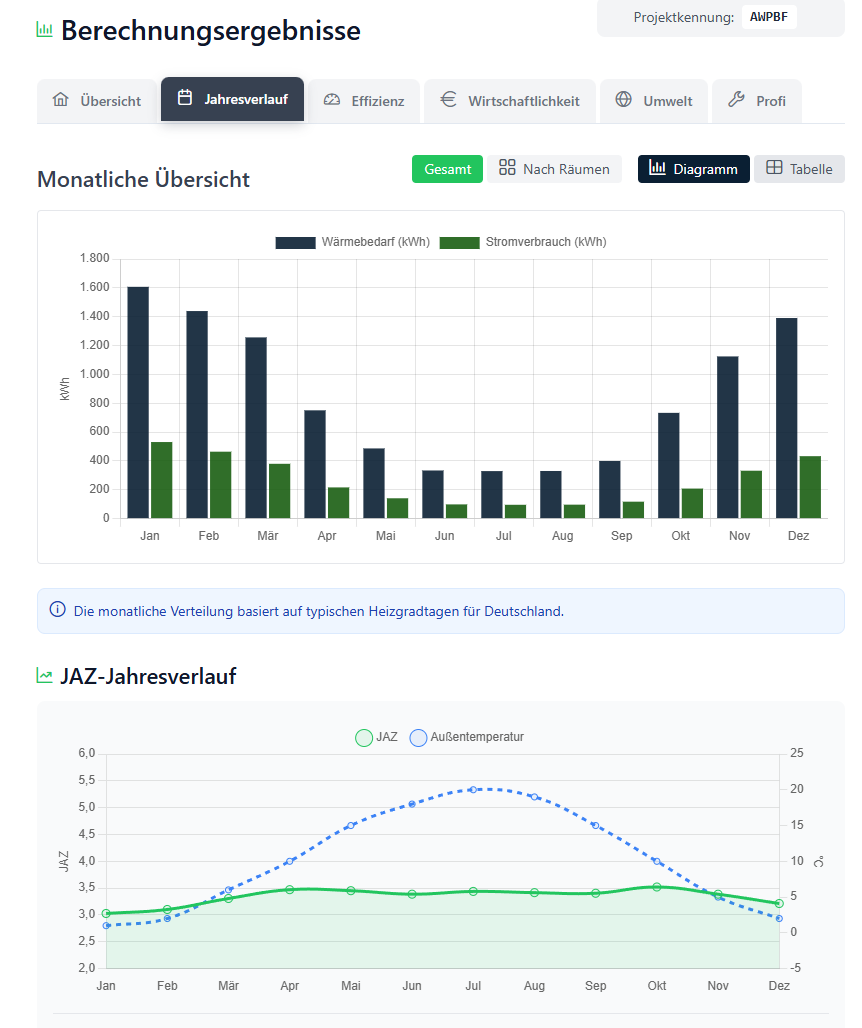
Calculate Seasonal Performance Factor (SPF) and operating costs per VDI 4650
The heat pump calculator determines your heat pump's efficiency over the entire year. You'll learn how economically a heat pump would operate in your building and what operating costs to expect.
What the calculator offers:
- Seasonal Performance Factor (SPF/JAZ) per VDI 4650
- SCOP calculation for different climate zones
- Electricity consumption for heating and hot water
- Operating costs and economic efficiency
- Comparison of different heat sources (air, ground, groundwater)
- Monthly efficiency breakdown
- CO₂ balance and environmental impact
Suitable for:
- Homeowners before heat pump purchase
- Planners for system design
- Energy consultants for renovation concepts
- Those interested in renewable heating systems
Further information:
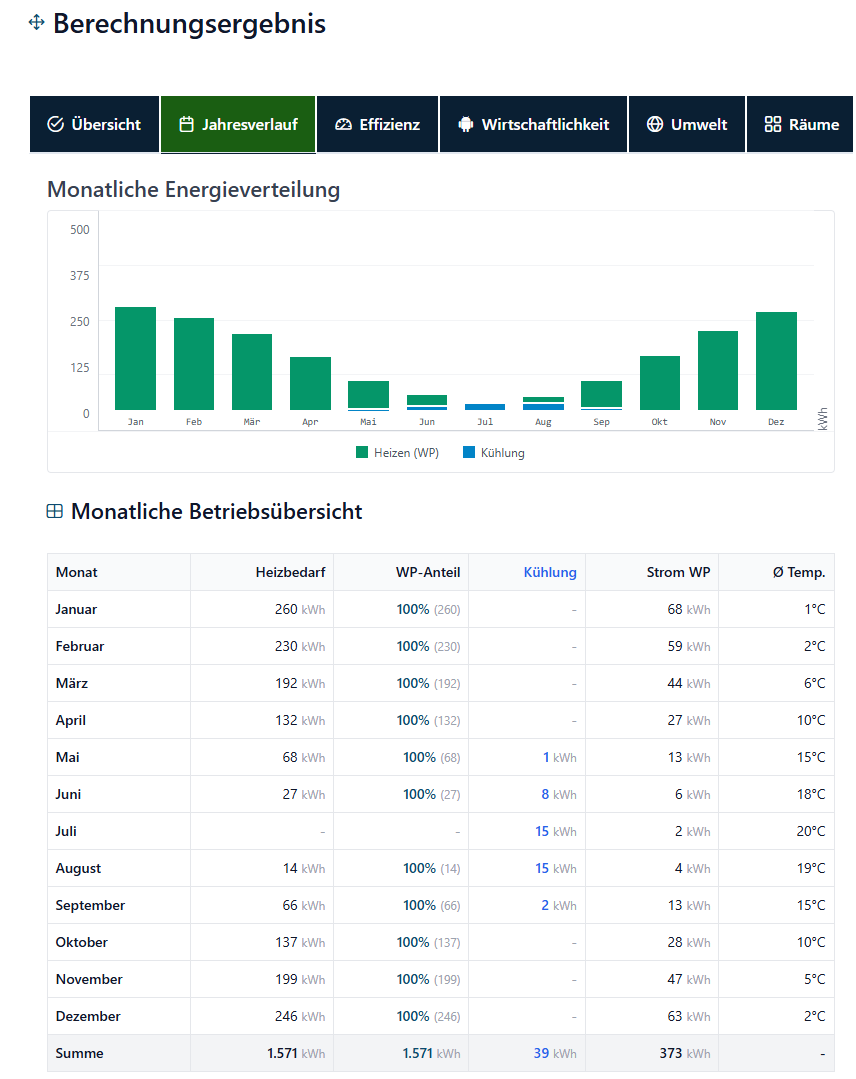
Calculate SCOP, SEER and operating costs for split air conditioning systems per EN 14825
The air-to-air heat pump calculator determines the efficiency of split air conditioning systems in both heating and cooling mode. Ideal for single-split and multi-split systems used for heating and cooling.
What the calculator offers:
- SCOP (heating) and SEER (cooling) per EN 14825
- Single-split and multi-split calculation
- Bivalent operation with existing gas heating
- Climate zones Average/Warmer/Colder
- Operating costs for heating and cooling
- CO₂ balance and economic efficiency
- Load profiles with TMY data
Suitable for:
- Homeowners with split air conditioning
- Planners of heating/cooling systems
- Those interested in air-to-air heat pumps
- Operators of multi-split systems
Further information:

Simulate PV yield and profitability with PVGis data
The solar calculator calculates the expected electricity yield of your photovoltaic system based on real weather data. You receive a realistic assessment of self-consumption, feed-in, and payback period.
What the calculator offers:
- PV yield based on PVGis satellite data
- Self-consumption quota and self-sufficiency degree
- Economic efficiency calculation with amortization
- Optimal orientation and tilt angle
- Battery storage sizing
- Integration with heat pump and electric vehicle
- Feed-in tariff and electricity price development
Suitable for:
- Homeowners before PV investment
- Planners and solar installers
- Investors evaluating profitability
- Electric vehicle and heat pump owners
Further information:
Why These Calculators?
Standards-compliant and precise
All calculators are based on recognized German and European standards:
- DIN EN 12831-1 for heating load calculation
- VDI 4650 for heat pump seasonal performance factor
- PVGis for solar yield simulation
The calculations correspond to the standards used by energy consultants and professional planners.
Free and ad-light
All calculators are completely free to use. No hidden costs, no registration, and no data sharing with third parties. Your entered data remains on your device or is stored encrypted.
Comprehensive catalogs
The calculators contain extensive databases:
- U-value catalog with over 200 building component combinations
- Climate data for all German cities per DIN 4108-2
- Radiator catalog with common types
- Heat pump characteristic curves for different heat sources
PDF export and documentation
All calculation results can be exported as professionally formatted PDFs. Ideal for:
- Contractor quotes
- Subsidy applications (BEG, KfW)
- Energy consulting reports
- Personal documentation
Frequently Asked Questions
Are the calculators really free?
Yes, all calculators are completely free and without restrictions. There are no hidden costs, premium features, or subscription models. Financing is through unobtrusive advertising.
How accurate are the calculations?
The calculators use the same standards and methods as professional planning software. The heating load calculation follows exactly DIN EN 12831-1, the SPF calculation follows VDI 4650. The results are sufficiently accurate for initial planning and sizing. For complex projects, we recommend verification by a professional planner.
Is my data stored?
You can optionally save projects with a project key and retrieve them later. Data is stored encrypted on our servers. Without a project key, all data remains only in your browser and is not transmitted. Details can be found in our privacy policy.
Can I use the results for subsidy applications?
The PDF exports contain all relevant information and calculation bases. However, most subsidy programs require an energy consultant with appropriate qualifications. The calculators can form the basis for their calculations and show you in advance whether a measure is worthwhile.
Which browsers are supported?
The calculators work in all modern browsers (Chrome, Firefox, Safari, Edge). For best display, we recommend a screen width of at least 1024 pixels. Mobile devices are supported, but input is more comfortable on larger screens.
Can I perform multiple calculations in parallel?
Yes, you can create and save as many projects as you like. With the project key system, you can calculate and compare different variants.
The Calculators in Detail
Heating Load Calculation – Why is it important?
The heating load is the decisive factor for sizing your heating system. It indicates how much heating power (in watts) is needed to bring your building to the desired room temperature at the lowest outdoor temperature.
Typical heating loads:
- Unrenovated old building: 80-120 W/m² living space
- Renovated old building: 40-60 W/m²
- New building per GEG: 30-45 W/m²
- KfW efficiency house 55: 25-35 W/m²
- Passive house: 10-15 W/m²
An oversized heating system is inefficient and expensive. An undersized system cannot keep the house warm. Standards-compliant calculation per DIN EN 12831-1 is therefore indispensable.
Heat Pump Efficiency – Understanding SPF and SCOP
The Seasonal Performance Factor (SPF) is the most important criterion for a heat pump's economic efficiency. It indicates how much heat the heat pump generates from one unit of electricity on average throughout the year.
Example: SPF = 4.0 means:
- 1 kWh electricity → 4 kWh heat
- 3 kWh come free from the environment
- Only 1 kWh must be paid for
Typical SPF values:
- Air-source heat pump: 3.0-4.0
- Ground-source heat pump: 4.0-5.0
- Water-source heat pump: 4.5-5.5
The higher the SPF, the lower the operating costs. Our calculator shows you what SPF is realistic in your specific case.
Solar Yield – What is realistic?
A photovoltaic system's yield depends on many factors: location, orientation, tilt angle, shading, and module quality. Our calculator uses real weather data from recent years (PVGis) for a realistic forecast.
Typical yields in Germany:
- South orientation, 30° tilt: 950-1,100 kWh/kWp per year
- East-West orientation, 10° tilt: 800-950 kWh/kWp
- Flat roof with mounting system: 900-1,050 kWh/kWp
Example: An 8 kWp system with south orientation generates about 8,800 kWh/year in Munich, about 8,000 kWh/year in Hamburg.
With battery storage and heat pump, self-consumption can be significantly increased – from typical 30% without storage to 60-80% with storage and flexible consumers.
Combining the Calculators
Heating Load + Heat Pump
The heating load is the basis for heat pump sizing. First use the Heating Load Calculator to determine the required heating power. Your heat pump must be able to provide at least this power.
With the Heat Pump Calculator, you then check how efficiently different heat pump types would work in your building.
Important: A low heating load enables low flow temperatures (35-40°C instead of 55-70°C), which significantly improves the SPF.
Heat Pump + Solar
The combination of heat pump and photovoltaics is particularly economical. Self-generated solar electricity significantly reduces the heat pump's operating costs.
Use the Solar Calculator to determine the optimal system size. For heat pumps, a larger PV system (10-15 kWp instead of 5-8 kWp) is usually recommended, as the additional electricity demand of the heat pump is 2,000-4,000 kWh/year.
With battery storage, you can also use solar electricity for the heat pump in winter.
Guides and Background Knowledge
We have created detailed guides and background articles for all calculators:
Guides
- Heating load calculation step by step
- Sizing heat pumps correctly
- Choosing the right air-to-air heat pump
- Planning solar systems
Technical articles
Contact and Support
Do you have questions about the calculators or have you found errors? Contact us – we're happy to help.
The calculators are continuously being developed. If you have suggestions for improvements or new features, we look forward to your feedback.