

Heat Pumps: The Anti-Fridge
Heat pumps use ambient and environmental heat for space heating and are among the most efficient technologies for buildings. Combined with photovoltaics they form a highly effective team for low‑carbon heating.
In the United Kingdom and Ireland, heat pumps are now central to national decarbonisation strategies. Design and installation should follow local standards such as:
- UK: MCS standards (e.g. MIS 3005 for heat pump design and installation), CIBSE Guides, and BS EN 12831 for heat load calculations (UK implementation of EN 12831).
- Ireland: NSAI adoption of I.S. EN 12831 for heating load and TGD Part L of the Building Regulations for energy performance.
- International (EU/other): EN 12831 for heat load and EN ISO 6946 for U‑value calculations, often implemented via national building codes.
Energy performance and compliance are assessed via:
- UK: Building Regulations Part L (Conservation of fuel and power) and SAP 10 / EPCs (Energy Performance Certificates).
- Ireland: Building Regulations Part L, the DEAP methodology and BER (Building Energy Rating) certificates.
- Other countries: Typically national implementations of the EPBD (Energy Performance of Buildings Directive) with their own EPC schemes.
Subsidies and incentives (replacing German BAFA/KfW references) include:
-
United Kingdom
- Boiler Upgrade Scheme (BUS): Grants of up to £7,500 for air‑source and ground‑source heat pumps in existing homes and some non‑domestic buildings in England and Wales, subject to MCS installation and minimum efficiency requirements.
- Home Energy Scotland Grants and Loans: Support for heat pumps, insulation and other measures in Scotland, with grant and interest‑free loan combinations.
- Northern Ireland schemes: Periodically available via local programmes; check current NI government or utility offers.
- Additional support may be available via local authority or social housing programmes.
-
Ireland
- SEAI Heat Pump System Grants: Typically €3,500–€6,500 depending on dwelling type and system, for homes built before 2021 that meet minimum fabric efficiency (insulation and airtightness) standards.
- SEAI Home Energy Grants: For insulation, windows and other efficiency measures, often combined with heat pump grants.
- Accelerated Capital Allowances (ACA): For businesses investing in qualifying energy‑efficient technologies, including heat pumps.
-
International
- Many EU countries offer grants or tax credits for heat pumps, insulation and PV under national implementations of the EU Green Deal and Recovery and Resilience plans. Always check current national energy agency information.
Energy labelling and performance declarations:
- Heat pumps placed on the UK and EU markets must carry an energy label under the Ecodesign and Energy Labelling regulations (e.g. Regulation (EU) 811/2013 as retained in UK law), showing SCOP, efficiency class and sound power.
- EPC/BER certificates rate the overall building, not just the heat pump, but a high‑efficiency heat pump and good insulation significantly improve the rating.
The complete guide

Everything about heat pumps in one article: how they work, types, costs, incentives and sizing – the ideal starting point.
Go to the guide →Fundamentals

The anti‑fridge: step‑by‑step through the operating principle – from evaporator to condenser.
Read The Anti-Refrigerator: How Does a Heat Pump Work? →
Heat exchangers, compressor and expansion valve – the key components in detail.
Read The Components: Heat Exchanger, Compressor and Expansion Valve →Performance indicators & sizing

COP, seasonal performance factor (SPF), bivalence point – the key figures for design and evaluation.
Read Heat Pump Key Figures and Sizing →
The seasonal coefficient of performance according to EN 14825 – how to correctly assess heat pump efficiency. In the UK and Ireland, SCOP values are used in product labels and in calculation tools such as SAP and DEAP.
Read SCOP Explained: How to Evaluate Heat Pump Efficiency →
From heating load to the right heat pump size – step‑by‑step with practical examples. In the UK and Ireland, heating loads are typically calculated to **BS EN 12831 / I.S. EN 12831** or via SAP/DEAP methods.
Read Heat Pump Sizing: From Heat Load to the Right Capacity →Operation & optimisation

A heat pump can operate on its own or alongside other heat sources – an overview of operating modes.
Read Operating Modes: Monovalent, Bivalent and Hybrid →
Heating curve, hydraulic balancing, room thermostats – how to gain 15–25% extra efficiency from your heat pump.
Read Heat Pump Settings: The Practical Guide →
From 500 to 10,000 kWh: What a heat pump's electricity consumption costs – by building type, radiators and heat source.
Heat Pump Electricity Consumption per Year: Calculate, Understand and Reduce Your Usage lesen →Types & solar integration

Air‑to‑water, ground‑source, water‑source – and how to combine them optimally with photovoltaics. In the UK and Ireland, PV‑powered heat pumps can significantly cut running costs and improve EPC/BER ratings.
Read Heat Pump Types and the Dream Team with Solar Systems →
Size your PV system correctly, maximise self-consumption, make smart use of battery storage – the practical guide to combining PV and heat pumps.
Read Solar and Heat Pump: The Perfect Dream Team for Affordable Heating →Costs & incentives

All costs at a glance: purchase, installation, operation and available grants – including long‑term 20‑year comparisons. For the UK and Ireland, this includes schemes such as the Boiler Upgrade Scheme and SEAI heat pump grants.
Read Heat Pump Costs 2026: Purchase, Installation and Operation →
Real savings potential compared: gas vs. oil vs. heat pump – with 20-year total cost analysis and carbon tax projections.
Read Heat Pump and Heating Costs: Real Savings Potential Compared to Gas and Oil →Existing buildings & older homes
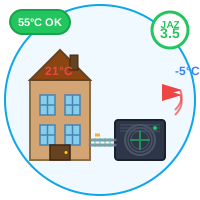
A practical guide for existing buildings: flow‑temperature tests (e.g. 50–55°C), renovation scenarios, hybrid systems and realistic costs – with reference to UK and Irish retrofit standards and grant requirements.
Read Heat pumps in older homes: requirements, solutions & costs →Heat pump types at a glance
| Type | Heat source | COP (typical) | Advantages |
|---|---|---|---|
| Air‑to‑water | Outdoor air | 3–4 | Lower upfront cost, straightforward installation |
| Ground‑source (brine‑to‑water) | Ground | 4–5 | Consistently high efficiency |
| Water‑source | Groundwater | 5–6 | Highest efficiency where conditions allow |