

Technical and Legal Requirements
Before purchasing a balcony power plant, technical, structural and legal requirements must be checked. This article includes the changes from Solar Package 1 (implemented 2024) plus clarifications from autumn 2025.
Technical Requirements
Mechanical and Structural Requirements
Before you buy, you should check the following points:
| Question | What to check? |
|---|---|
| Does the balcony power plant fit? | Check module dimensions |
| Is there enough space? | Plan min. 1.7 m² per module |
| Is the structure strong enough? | Check load capacity of balcony/railing |
| How will it be mounted? | Choose suitable bracket |
| Wind and weather protection? | Ensure storm-proof mounting |
Weight and Structural Capacity
| Component | Typical weight |
|---|---|
| Solar module (400 Wp) | 18–22 kg |
| Inverter | 1–3 kg |
| Bracket | 3–8 kg |
| Total per module | approx. 25–35 kg |
Important: For older balconies or railings, have the structural capacity checked. If in doubt, consult a specialist.
Electrical Requirements (as of 12/2025)
| Requirement | Details |
|---|---|
| Inverter | VDE-AR-N 4105:2024-07 (protection and shutdown requirements) |
| Max. AC feed-in | 800 W active power per household |
| Max. module power | 2,000 Wp per balcony power plant |
| Plug device | Schuko up to 800 W explicitly permitted per DIN VDE V 0628-1; Wieland optional |
| Electricity meter | Bidirectional meter or modern metering device/smart meter; Ferraris meters not permitted |
| RCD/RCBO | Type A ≥ 30 mA (for older systems check Type A-EV/B if needed) |
| Cable | UV-resistant, adequate cross-section, strain-relieved and weatherproof installation |
Weather and Location Conditions
Optimal Tilt Angle
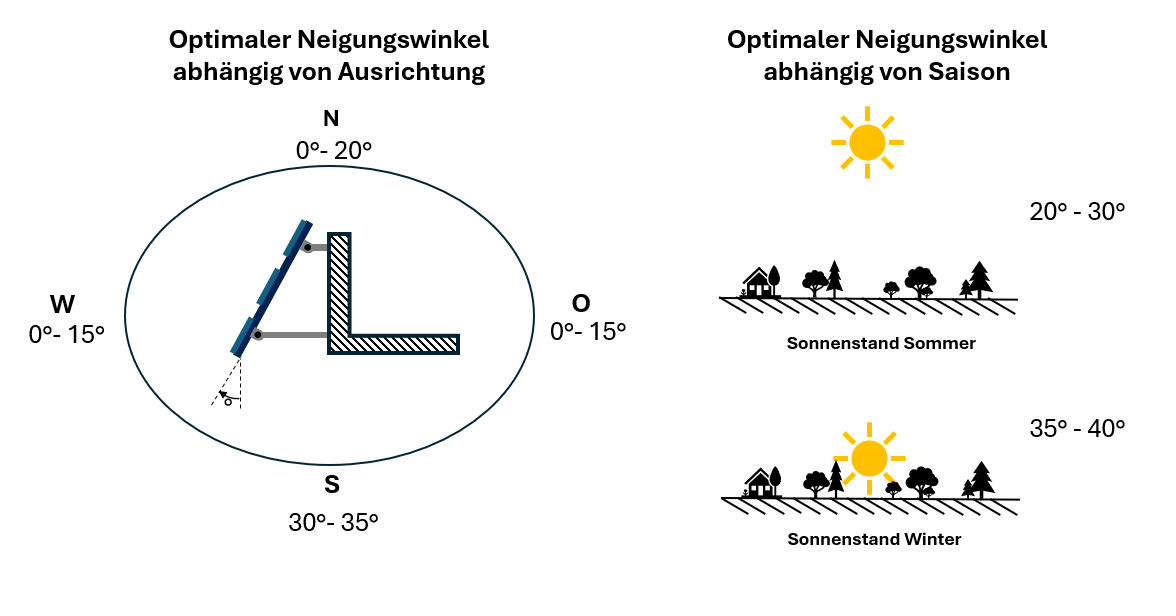 Tilt angle depending on orientation and season
| Orientation | Optimal tilt angle |
|---|---|
| South | 30°–35° |
| East/West | 0°–15° |
| North | 0°–20° (low yield) |
Seasonal Differences
| Season | Recommended angle | Reason |
|---|---|---|
| Summer | 20°–30° | Sun is high |
| Winter | 35°–40° | Sun is low |
| Year-round optimal | 30°–35° | Compromise |
Effect on Efficiency
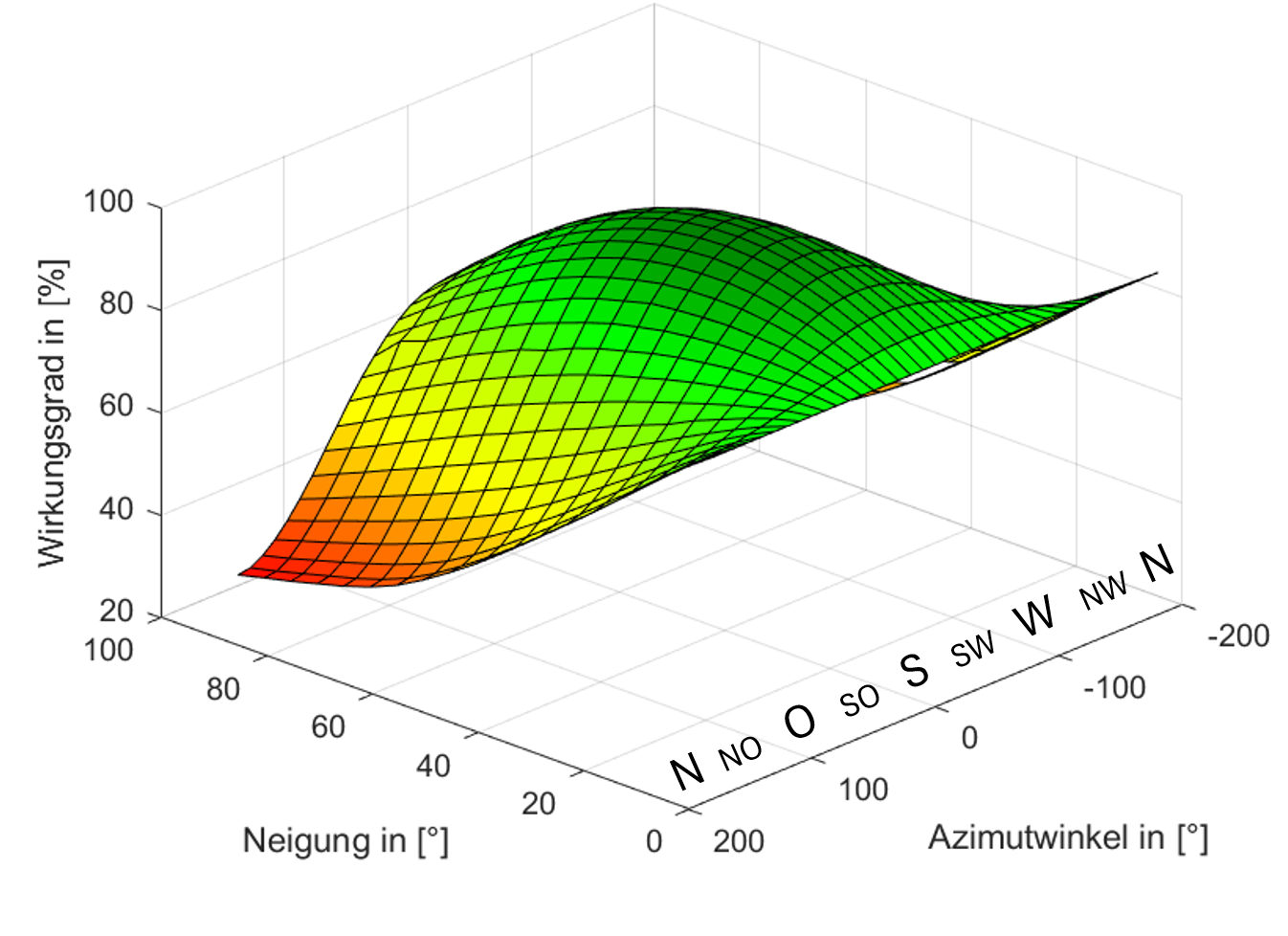 3D representation: Optimal at south with 30°–35° tilt
Orientation (Azimuth)
| Orientation | Relative yield | Recommendation |
|---|---|---|
| South (0°) | 100% | Ideal |
| Southeast/Southwest | 95% | Very good |
| East/West | 80–85% | Good |
| Northeast/Northwest | 60–70% | Conditionally suitable |
| North | 50–60% | Not recommended |
Shading
Shading is one of the biggest yield killers:
| Shading type | Effect | Solution |
|---|---|---|
| Permanent shade (buildings) | Strongly negative | Change location |
| Temporary shade (trees) | Moderately negative | Optimisers/module inverters |
| Partial shading | Negative | Bypass diodes in module |
Tip: Use online tools like the PVGIS calculator from the EU to calculate the expected yield for your location.
Legal Requirements (as of 12/2025)
Solar Package 1 has been implemented: 800 W AC, 2,000 Wp modules and Schuko are permitted; registration processes have been simplified.
Technical Limits per EEG / DIN
| Requirement | Value |
|---|---|
| Max. module power | 2,000 Wp per system |
| Max. inverter power | 800 W AC feed-in |
| Grid operator notification | Simplified notification; many operators retrieve data from MaStR |
| MaStR registration | Mandatory (simplified questionnaire) |
| Plug device | Schuko up to 800 W permitted; Wieland optional |
Important Laws and Standards
| Law/Standard | Content |
|---|---|
| EEG § 3 No. 43 | Definition of balcony power plant |
| EEG § 2 Para. 12 | Technical requirements |
| WEG/BGB | Right to balcony power plant for tenants |
| VDE-AR-N 4105:2024-07 | Technical connection requirements |
| DIN VDE V 0628-1 | Plug-ready generation systems (Schuko) |
| UStG | 0% VAT on PV systems |
Tenant Rights Since 2024
- Tenants have a fundamental right to a balcony power plant.
- Landlords can only refuse for compelling technical reasons.
- No intervention in building fabric required (consider clamp brackets/heavy-duty anchors).
Registration in the Market Master Data Register
Since 2024, only registration in the Market Master Data Register (MaStR) is required.
Step by Step
- Visit the website: www.marktstammdatenregister.de
- Start registration: "Register a system"
- Select system type: Solar system → Plug-ready solar system
- Complete questionnaire: Location, power, commissioning date
- Create user account (if not already existing)
- Enter technical data: Meter number, module power, inverter power
- Complete and receive confirmation
Note: Off-grid systems without grid connection are exempt from the registration requirement.
Required Data
| Data | Source |
|---|---|
| Personal data | Name, address |
| Location | Address, coordinates if applicable |
| Module power (Wp) | Module datasheet |
| Inverter power (W) | Inverter datasheet |
| Meter number | Read from electricity meter |
| Commissioning date | Date of first feed-in |
Feed-in Tariff
| Aspect | Details |
|---|---|
| Tariff possible? | Theoretically yes, practically rarely economical |
| Tariff level | Approx. 8 ct/kWh (as of 2025) |
| Effort | High administrative effort |
| Recommendation | Maximise self-consumption |
In Brief: The feed-in tariff is hardly worthwhile for balcony power plants. Every kWh consumed saves approx. 30–35 ct compared to grid purchase.
Checklist: Am I Ready?
Technical:
- [ ] Space for 1–2 modules
- [ ] Load-bearing structure (balcony/railing)
- [ ] Socket within reach
- [ ] Bidirectional meter / modern metering device
Environment:
- [ ] Good orientation (south, southeast, southwest)
- [ ] No or minimal shading
- [ ] Tilt angle adjustable
Legal:
- [ ] Landlord informed (for rented accommodation)
- [ ] MaStR registration planned
Conclusion
In Brief: Good south orientation, minimal shading and 30°–35° tilt deliver the best yield. Legally, 800 W AC suffices, Schuko up to 800 W is permitted, and a brief online registration in the Market Master Data Register completes the formalities.
Back to overview: All Balcony Power Plant Articles
Sources
- Federal Network Agency: Market Master Data Register
- BMWK: Solar Package 1
- VDE: VDE-AR-N 4105
- SFV: Yield Estimation
- Konrad Mertens: Photovoltaik - Lehrbuch zu Grundlagen, Technologie und Praxis, 2022