
SCOP Explained: How to Evaluate Heat Pump Efficiency
Why the SCOP Matters
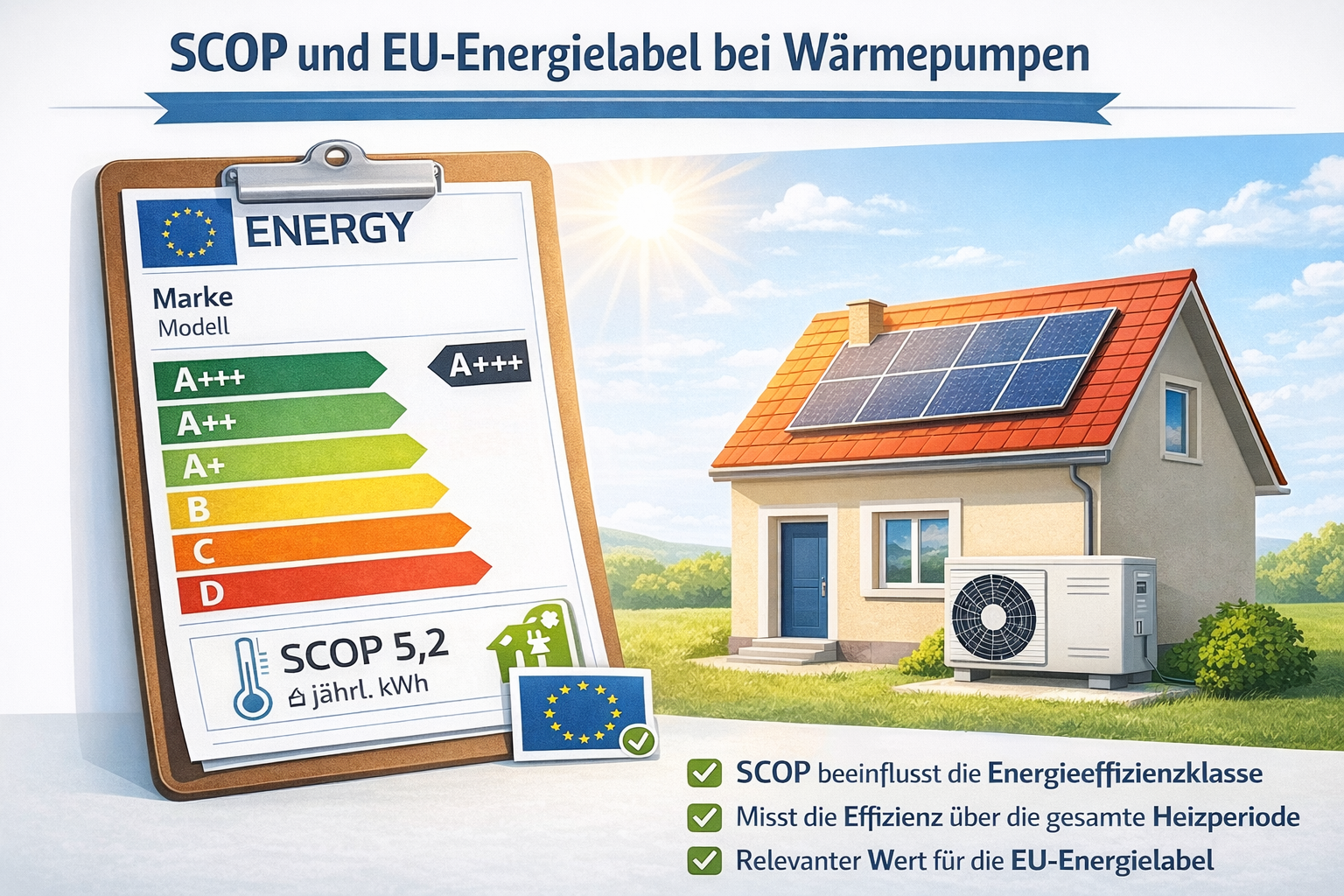
Anyone looking to buy a heat pump will inevitably encounter efficiency metrics like COP, SCOP, and SPF. The SCOP has established itself as the central figure: it appears on the EU energy label, determines subsidy eligibility, and enables realistic comparison between different units.
Unlike the COP, which represents only a momentary value under laboratory conditions, the SCOP reflects efficiency over a complete heating season. This accounts for varying outdoor temperatures throughout the year – from mild autumn days to cold winter nights.
This article explains how the SCOP is calculated, what values are considered good, and what to look for when comparing heat pumps.
What is the SCOP?
SCOP stands for Seasonal Coefficient of Performance – a seasonally-adjusted performance coefficient. The value indicates how much heat energy a heat pump generates on average during a heating season from one kilowatt-hour of electricity.
The calculation follows the European standard EN 14825. Unlike the COP, which is measured at a single temperature, the SCOP incorporates multiple operating points.
The Four Measurement Points
For the middle climate zone (which includes Germany and most of Central Europe), COP values are determined at the following outdoor temperatures:
| Measurement Point | Outdoor Temperature | Share of Heating Season |
|---|---|---|
| Point 1 | +12 °C | Transition period (frequent) |
| Point 2 | +7 °C | Mild winter |
| Point 3 | +2 °C | Normal winter |
| Point 4 | –7 °C | Cold winter (rare) |
These individual values are then combined with weighting. Since mild temperatures occur more frequently in Central Europe than severe frost, the measurement points at +7 °C and +2 °C have the greatest influence on the SCOP.
Mind the Flow Temperature
The SCOP is specified for different flow temperatures. Common designations are:
- SCOP 35 (also LT for Low Temperature): For low-temperature systems like underfloor heating
- SCOP 55 (also MT for Medium Temperature): For conventional radiators
The SCOP 35 is always higher than the SCOP 55 because the heat pump operates more efficiently at lower flow temperatures. The EU energy label standardly shows the SCOP for 55 °C – this is the more relevant value for consumers, as many existing buildings require higher flow temperatures.
The Three European Climate Zones
The EU divides Europe into three climate zones with different temperature profiles for SCOP calculation:
| Climate Zone | Reference Location | Typical Countries | Additional Measurement Point |
|---|---|---|---|
| Northern Europe | Helsinki | Finland, Sweden, Norway | –15 °C |
| Central Europe | Strasbourg | Germany, Austria, Switzerland, France | – |
| Southern Europe | Athens | Greece, Spain, Italy | +2 °C omitted |
The EU energy label always shows the SCOP for the middle climate zone (Strasbourg profile). Manufacturers may additionally specify values for other zones.
For buyers in Central Europe, the Strasbourg profile is appropriate. Those living in alpine regions or northern areas should consider that actual efficiency may be somewhat lower than the stated SCOP.
SCOP vs. COP vs. SPF – The Difference
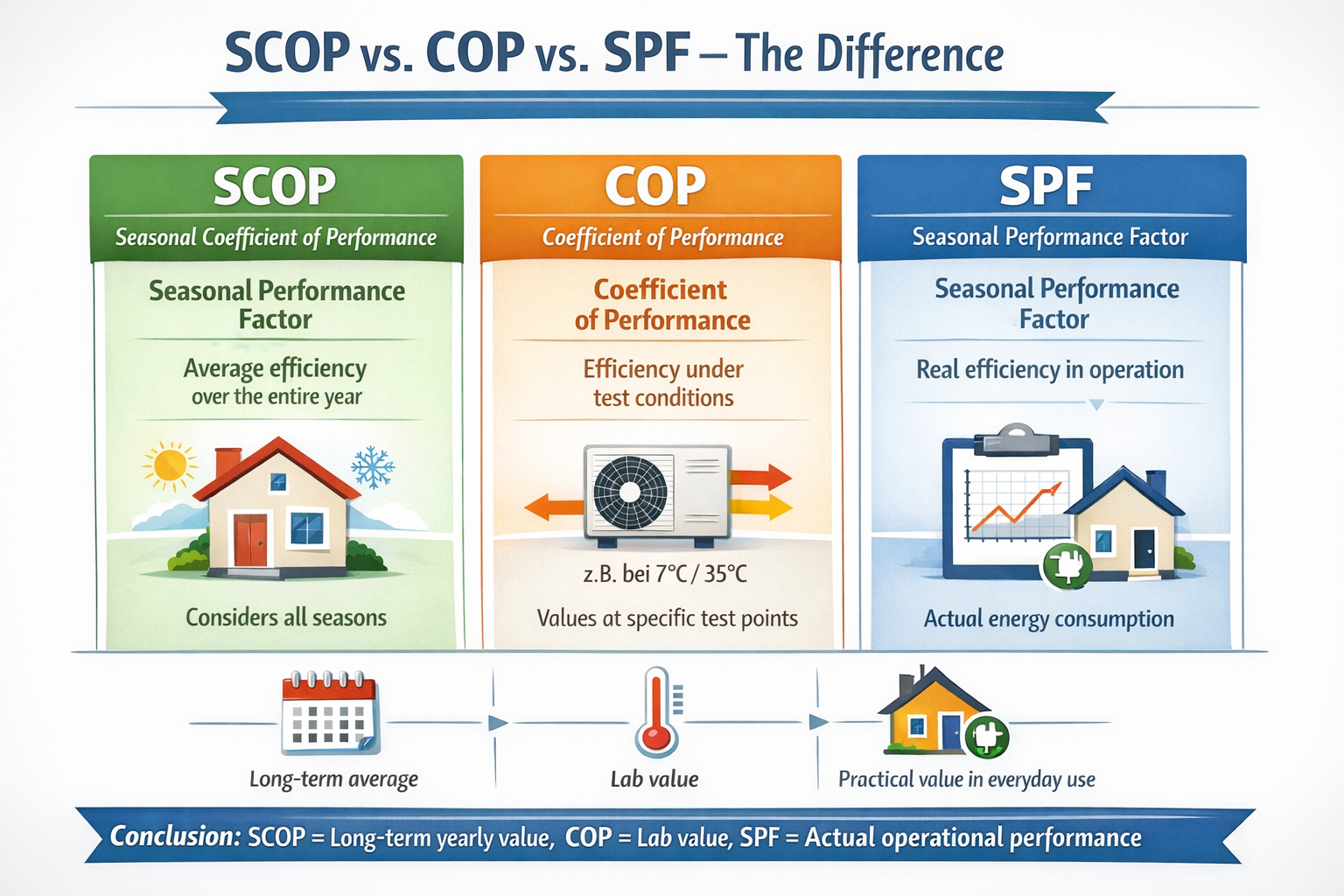
These three metrics are often confused, although they make different statements:
COP (Coefficient of Performance)
The COP is a momentary value under standardised laboratory conditions. It is measured according to EN 14511 at fixed temperatures, for example:
- A2/W35: Air 2 °C, flow temperature 35 °C
- B0/W35: Brine (ground) 0 °C, flow temperature 35 °C
The COP is suitable for direct technical comparison of units under identical conditions. However, it says little about efficiency in real operation.
SCOP (Seasonal COP)
The SCOP is a weighted average of multiple COP values over a typical heating season. It is more realistic than the COP because it considers various outdoor temperatures. The SCOP forms the basis for the EU energy label and subsidy requirements.
SPF (Seasonal Performance Factor)
The SPF is the actual efficiency value of an installed heat pump over an entire operating year. It can only be measured after installation and considers all individual factors: building insulation, user behaviour, regional climate, system settings.
When Each Value is Relevant
| Situation | Relevant Metric |
|---|---|
| Comparing units before purchase | SCOP (and COP for technical comparison) |
| Applying for subsidies | ηs (based on SCOP) |
| Checking efficiency of own system | SPF |
| Creating energy certificate | SPF according to VDI 4650 |
What is a Good SCOP Value?
Achievable SCOP values depend heavily on the heat pump type and flow temperature. Generally: the more constant the heat source, the higher the SCOP.
Reference Values by Heat Pump Type
At 35 °C flow temperature (underfloor heating):
| Heat Pump Type | Average | Good | Very Good |
|---|---|---|---|
| Air-to-water | 3.5–4.0 | 4.0–4.5 | > 4.5 |
| Ground source | 4.2–4.7 | 4.7–5.2 | > 5.2 |
| Water-to-water | 5.0–5.5 | 5.5–6.5 | > 6.5 |
At 55 °C flow temperature (radiators):
| Heat Pump Type | Average | Good | Very Good |
|---|---|---|---|
| Air-to-water | 2.8–3.2 | 3.2–3.6 | > 3.6 |
| Ground source | 3.3–3.8 | 3.8–4.2 | > 4.2 |
| Water-to-water | 4.0–4.5 | 4.5–5.0 | > 5.0 |
Why Ground Source Heat Pumps Perform Better
Air-to-water heat pumps have a systematic disadvantage: when it's coldest outside and heating demand is highest, efficiency drops. At –7 °C outdoor temperature, an air-to-water heat pump operates significantly less efficiently than at +7 °C.
Ground source and water-to-water heat pumps, however, use heat sources with nearly constant temperatures: the ground at 1.5 m depth maintains approximately 8–12 °C year-round, and groundwater consistently stays at 8–12 °C. These stable conditions enable higher SCOP values.
Inverter Technology Improves SCOP
Modern heat pumps with inverter technology can continuously adjust their output to demand. In partial load operation – that is, in mild weather when little heating output is needed – they work particularly efficiently.
Inverter modulation can achieve SCOP improvements of 8–15% compared to fixed-speed heat pumps. Top devices today achieve SCOP values above 5.0 at 35 °C flow temperature.
ηs: The Seasonal Space Heating Energy Efficiency
For subsidies in Germany (BAFA and KfW), the decisive factor is not the SCOP directly but the derived ηs value (Greek: eta-s). ηs represents the seasonal space heating energy efficiency and is expressed as a percentage.
The Formula
ηs (%) = (SCOP ÷ 2.5) × 100
The divisor 2.5 is the primary energy factor for the European electricity mix. It accounts for the fact that generating 1 kWh of electricity requires approximately 2.5 kWh of primary energy at the power plant.
Calculation Examples
| SCOP | ηs Calculation | ηs |
|---|---|---|
| 3.0 | 3.0 ÷ 2.5 × 100 | 120% |
| 3.5 | 3.5 ÷ 2.5 × 100 | 140% |
| 4.0 | 4.0 ÷ 2.5 × 100 | 160% |
| 4.5 | 4.5 ÷ 2.5 × 100 | 180% |
| 5.0 | 5.0 ÷ 2.5 × 100 | 200% |
An ηs above 100% means: more heating energy is generated from the primary energy input than would be possible through direct combustion.
Subsidy Requirements
For the German Federal Subsidy for Efficient Buildings (BEG), minimum requirements apply for the ηs value:
| Heat Pump Type | ηs 35 min. | ηs 55 min. |
|---|---|---|
| Air-to-water (electric) | 135% | 120% |
| Ground source (electric) | 150% | 135% |
| Water-to-water (electric) | 150% | 135% |
An ηs 35 of 135% corresponds to a SCOP of 3.375. Most current air-to-water heat pumps easily meet this requirement.
SCOP on the EU Energy Label
Since 2019, all heat pumps must carry an EU energy label. The efficiency scale ranges from A+++ (best class) to D (lowest still permitted class).
What the Label Shows
The energy label for heat pumps contains:
- The energy efficiency class (A+++ to D)
- The heating output in kW
- The sound power level in dB(A)
- The SCOP for the middle climate zone at 55 °C flow temperature
Efficiency Classes and SCOP
| Efficiency Class | SCOP (at 55 °C) | Typical Heat Pumps |
|---|---|---|
| A+++ | ≥ 5.1 | Best ground source and water heat pumps |
| A++ | 4.6–5.1 | Good ground source, best air-to-water |
| A+ | 4.0–4.6 | Standard air-to-water heat pumps |
| A | 3.4–4.0 | Basic models |
Most air-to-water heat pumps achieve A++ at 35 °C flow temperature but only A+ at 55 °C. Ground source and water heat pumps achieve A++ or A+++ even at higher flow temperatures.
Practical Example: SCOP Comparison with Cost Calculation
A concrete example shows how different SCOP values affect operating costs.
Initial Situation
- Single-family home with 150 m²
- Heat demand: 15,000 kWh per year
- Electricity price: €0.30/kWh
Comparison of Two Heat Pumps
| Feature | Heat Pump A | Heat Pump B |
|---|---|---|
| Type | Air-to-water | Air-to-water |
| SCOP (55 °C) | 3.2 | 3.8 |
| Purchase price | €12,000 | €15,000 |
Electricity Consumption and Costs
Heat Pump A (SCOP 3.2):
- Electricity consumption: 15,000 kWh ÷ 3.2 = 4,688 kWh/year
- Electricity costs: 4,688 × €0.30 = €1,406/year
Heat Pump B (SCOP 3.8):
- Electricity consumption: 15,000 kWh ÷ 3.8 = 3,947 kWh/year
- Electricity costs: 3,947 × €0.30 = €1,184/year
Savings and Payback
The more efficient Heat Pump B saves €222 annually in electricity costs. The additional cost of €3,000 is thus recovered in approximately 13.5 years – faster with rising electricity prices.
Tip: With our Heat Pump Calculator you can calculate the seasonal performance factor and operating costs for your individual situation according to VDI 4650.
Conclusion
The Bottom Line: The SCOP is the most meaningful metric for comparing heat pump efficiency before purchase. It accounts for the seasonal temperature fluctuations of a heating period and forms the basis for the EU energy label as well as subsidy requirements. When evaluating, always note the specified flow temperature: the SCOP 35 for low-temperature systems is always higher than the SCOP 55 for conventional radiators. Ground source and water heat pumps fundamentally achieve higher SCOP values than air-to-water heat pumps due to their constant heat source.
In daily operation, the actual efficiency value – the seasonal performance factor (SPF) – will deviate from the SCOP because individual factors such as building insulation, heating behaviour, and regional climate come into play. Nevertheless, the SCOP remains the best available comparison value for the purchasing decision.
Heat Pump Article Series
| No. | Article | Topic |
|---|---|---|
| 0 | Heat Pump: The Complete Guide | Overview and introduction |
| 1 | The Anti-Refrigerator: How Does a Heat Pump Work? | Physical fundamentals |
| 2 | The Components: Heat Exchanger, Compressor and Expansion Valve | Components in detail |
| 3 | Key Figures and Sizing of Heat Pumps | COP, SPF, sizing |
| 4 | Operating Modes: Monovalent, Bivalent and Hybrid | Operating modes explained |
| 5 | Heat Pump Types and the Dream Team with Solar Systems | Types & combination with PV |
| 6 | SCOP Explained: Evaluating Heat Pump Efficiency | You are here |
Further Reading
The article Key Figures and Sizing explains further important metrics like GWP (global warming potential of the refrigerant) and provides rules of thumb for proper sizing. Those interested in combining heat pumps with photovoltaics will find practical recommendations in the article Heat Pump Types and the Dream Team with Solar Systems.
Sources
- EN 14825: Test and rating conditions for rating
- German Heat Pump Association: Energy label information
- BAFA: List of eligible heat pumps with efficiency certification
- SBZ-Online: Understanding COP, SCOP and ESCOP
- Energie-Experten: ηs for heat pumps
- VDI 4650: Calculation of seasonal performance factor for heat pump systems
Calculate Your SPF Now
With our free Heat Pump Calculator, calculate the seasonal performance factor of your heat pump according to VDI 4650 – including operating costs and CO₂ balance.