


From Photon to Volt: How Does a Solar Cell Work?
Introduction: Solar Energy in Semiconductors
Whether solar system, solar module or solar cell: all these terms contain the word "solar" – derived from the Latin "solaris", meaning "pertaining to the sun". The warm rays of our star offer enormous technical benefits beyond their life-sustaining function.
At the heart of every photovoltaic system lies the same principle: light energy is converted directly into electrical energy. This works because special semiconductors such as silicon can release electrons when exposed to light. This article explains exactly how this process occurs.
The Photovoltaic Effect: The Foundation
In the photovoltaic effect, incoming photons (light particles) knock electrons out of their atom-bound orbits under certain material conditions. But how does light become usable electricity? This is where the P-N junction comes into play.
What is a P-N Junction?
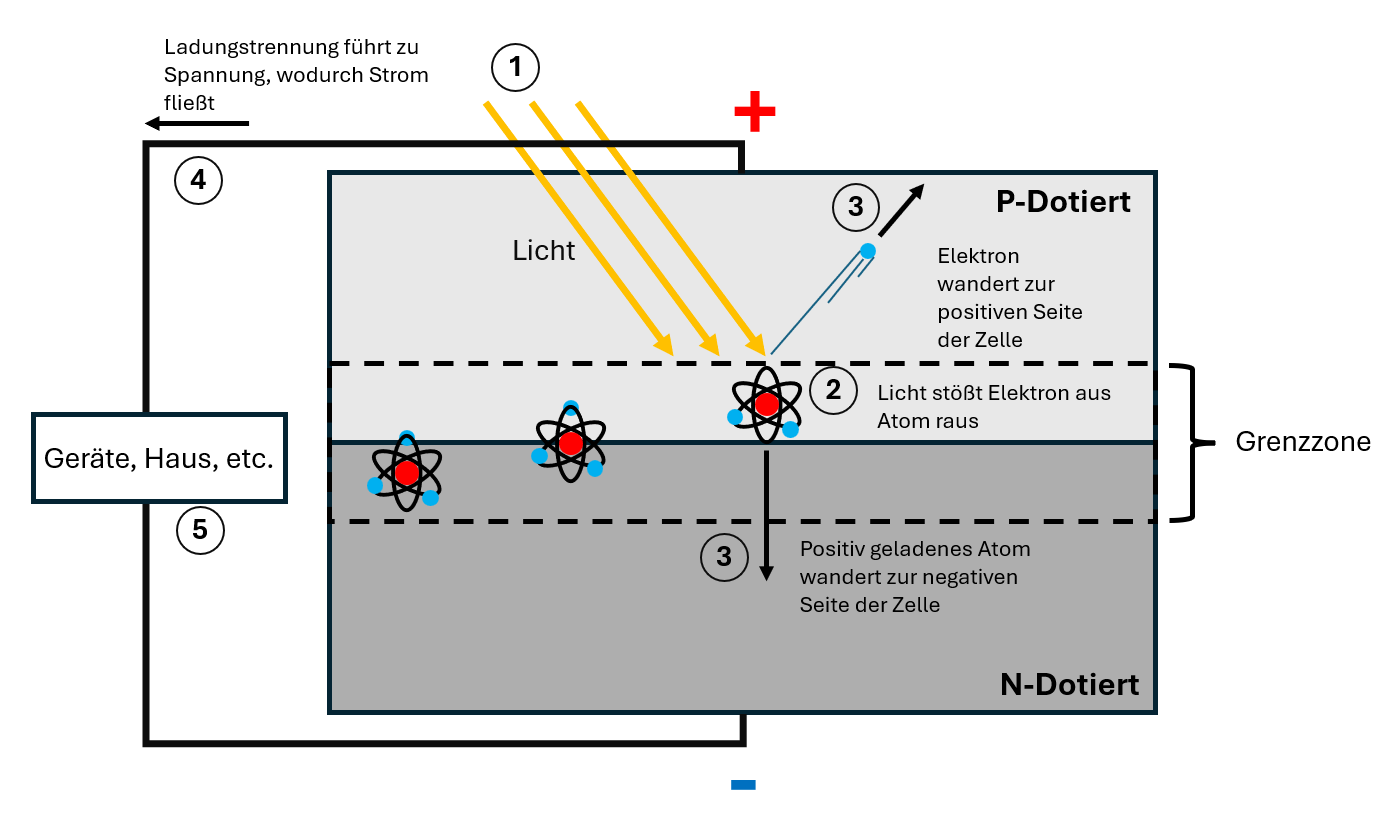
The P-N junction describes a boundary zone between two different semiconductor materials with special conducting properties. This boundary zone is created through doping – the deliberate introduction of foreign atoms into the silicon:
- P-doped silicon (e.g. with boron): Has free electron sites, acts as the positive side (acceptor atoms)
- N-doped silicon (e.g. with phosphorus): Has free electrons, acts as the negative side (donor atoms)
- Space charge region: An electric field forms at the boundary between P and N regions, responsible for charge separation
The free electrons at the boundary of the N-type material migrate to the free electron sites of the P-type material. This creates the electric field in the junction zone.
From Photon to Voltage: The Process Step by Step
The entire process from photon to volt can be explained through the following steps:
- Photon strikes the junction zone: A light particle reaches the P-N junction or its vicinity
- Electron breaks free: The photon transfers its energy to an electron, which detaches from the atom and leaves behind a positively charged "hole"
- Charge separation: The electric field of the space charge region drives electrons to the N-side and holes to the P-side
- Voltage develops: The spatial separation of charges creates a usable electrical voltage
- Current flows: When a load is connected, electrical current flows – household appliances, heat pumps or other applications can be powered
Einstein and the Photoelectric Effect
What many do not know: Albert Einstein received the Nobel Prize not for the world-famous theory of relativity with the formula E=mc², but for explaining the photoelectric effect in 1921. The photovoltaic effect is a special case of the photoelectric effect.
Without Einstein's insights, modern technologies such as smartphones, the internet, microchips and indeed photovoltaic systems would not have been possible.
Key Characteristics of a Solar Cell
Module Efficiency
Efficiency indicates how much of the incident solar energy is actually converted into electrical energy:
- Monocrystalline modules: 18–24% (highest efficiency)
- Polycrystalline modules: 15–20% (good value for money)
- Thin-film modules: 8–15% (easy integration, flexible applications)
- Experimental cells: Up to 47% in laboratory conditions (tandem solar cells)
For comparison: an old incandescent bulb converts only about 5% of energy into light – the rest is lost as heat.
Temperature Coefficient
Rising module temperature reduces voltage and thus output. Typical values:
- For every 1°C temperature increase, output drops by approximately 0.3–0.5%
- At 40°C module temperature instead of 25°C (standard condition), a module already loses 4.5–7.5% of its output
Shading and Bypass Diodes
Partial shading of a module significantly reduces current – not just proportionally to the shaded area. Bypass diodes limit these yield losses by routing around shaded cells.
Material Comparison at a Glance
| Technology | Efficiency | Advantages | Disadvantages |
|---|---|---|---|
| Monocrystalline | 18–24% | Highest efficiency, long lifespan | Higher cost |
| Polycrystalline | 15–20% | More affordable, proven technology | Slightly lower efficiency |
| Thin-film | 8–15% | Flexible, lightweight, partial-shade tolerant | Lowest efficiency |
Conclusion
Key Point: The solar cell is the heart of every photovoltaic system. Through the photovoltaic effect and the clever construction of doped semiconductors, sunlight is converted directly into electrical current.
Continue reading: In the next article Structure of a PV System: From Module to Grid Feed-in, you will learn how individual cells become complete solar systems and how the electricity reaches your socket.
Sources and Further Reading
- Elektrokompendium: Semiconductors and Doping
- LeifiPhysik: Silicon Solar Cells
- HTW Berlin: Efficiency Guide for PV Storage Systems
- Solarwissen: Doping Simply Explained
Calculate Your PV Yield Now
Our free Solar Calculator uses current PVGis data to calculate the expected electricity yield, self-consumption and economic viability of your photovoltaic system.