

What Is a Balcony Power Plant?
Sustainability and environmental awareness are more important today than ever. When it comes to sustainable energy generation, many people immediately think of solar systems. But what if you rent your home or lack space for a large PV system?
The solution: Balcony power plants – small, space-saving solar systems that can be mounted on balconies, terraces or building facades.
The Balcony Power Plant Boom
The statistics are impressive: The number of balcony power plants commissioned in Germany has increased nearly tenfold between 2022 and 2024. The reasons:
- Technological progress: Components are becoming cheaper and more efficient
- Legal simplifications: Since 2024, tenants have the right to a balcony power plant
- Simplified registration: Only registration in the Market Master Data Register required
Definition: What Exactly Is a Balcony Power Plant?
According to the Renewable Energy Sources Act (EEG) and the Federal Network Agency, a balcony power plant (also called plug-in solar device) refers to small PV systems with the following characteristics:
| Property | Value |
|---|---|
| Max. module power | 2,000 Wp |
| Max. inverter power | 800 W |
| Typical number of modules | 1–2 modules |
| Connection | Schuko or Wieland plug |
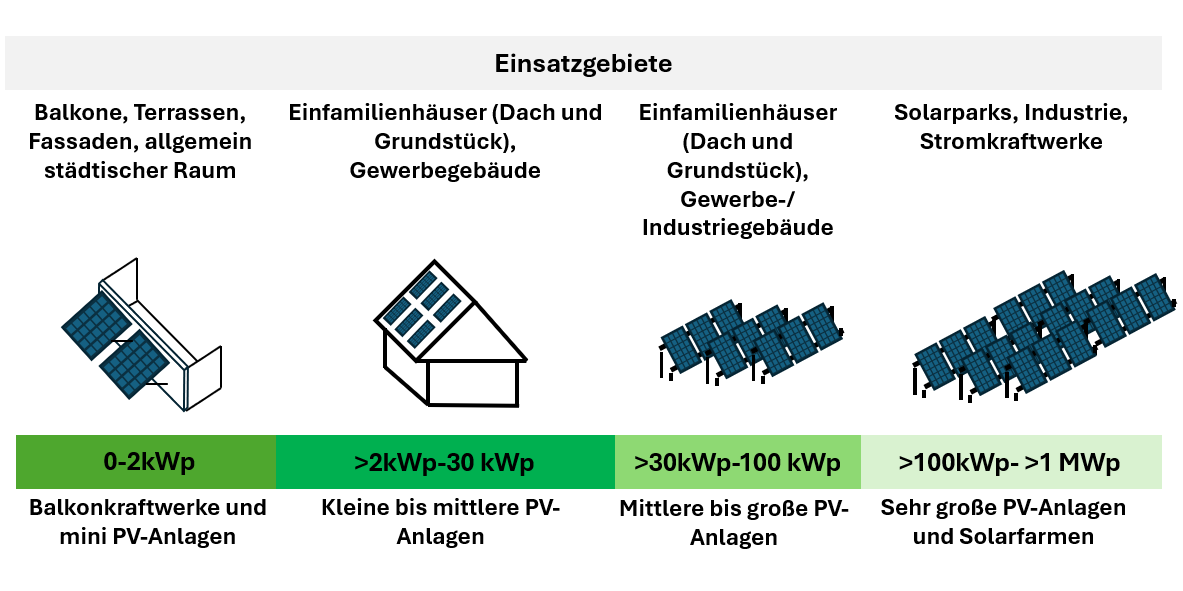 Balcony power plants (0–2 kWp) compared to other solar systems
How Does a Solar Cell Work?
The operation of a solar cell is based on the photovoltaic effect: When light strikes a solar cell, electrons are released from the material and generate electricity.
The PN Junction
A solar cell consists of two differently doped semiconductor layers:
- P-doped layer: Has free electron spaces ("holes")
- N-doped layer: Has excess electrons
At the boundary zone (PN junction), an electric field is created that enables charge separation.
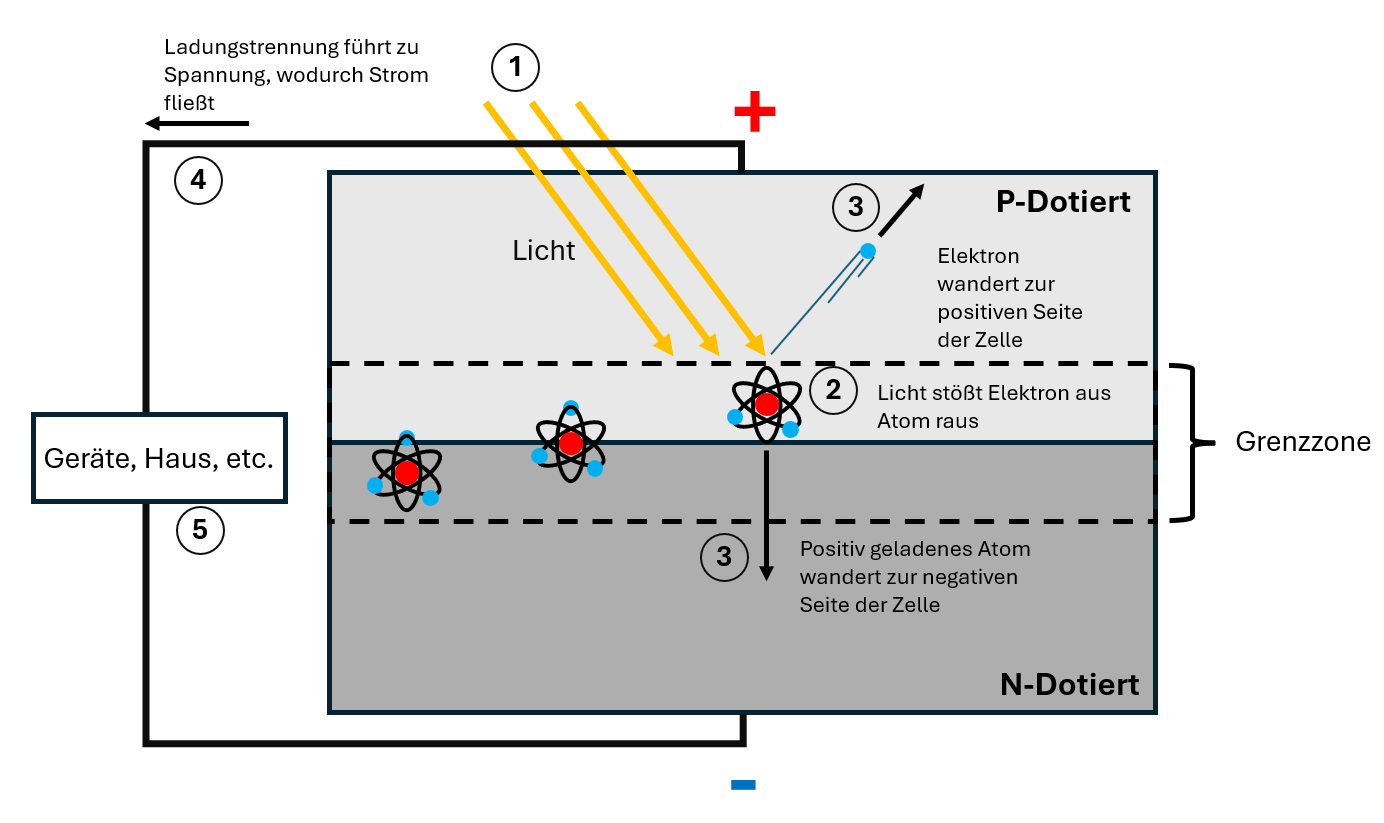 The photovoltaic effect: From sunlight to electricity in 5 steps
The Path from Photon to Socket
- Photon strikes electron: Light releases an electron from the atom
- Charge separation: Electron migrates to the positive side, the atom to the negative
- Voltage is generated: The charge separation creates a usable voltage
- Current flows: Current can be drawn off via the contacts
- Usage: Household appliances can be powered
Basic Solar Technology Terms
To better understand the relationships, here are the most important terms:
| Term | Explanation |
|---|---|
| Solar cell | Smallest unit, converts light into electricity |
| Solar module | Many solar cells connected together |
| Solar string | Several modules connected together |
| Inverter | Converts direct current (DC) to alternating current (AC) |
| MPPT | Maximum Power Point Tracker, optimises output |
Advantages of a Balcony Power Plant
| Advantage | Description |
|---|---|
| Simple installation | Often possible without specialist personnel |
| Low costs | Complete sets from approx. €300–600 |
| Tenant-friendly | No intervention in building fabric required |
| Quick payback | Often within 3–5 years |
| Environmentally friendly | Reduces carbon footprint |
| Portable | Can be taken along when moving |
Disadvantages and Limitations
| Disadvantage | Description |
|---|---|
| Limited power | Max. 800 W feed-in |
| Location-dependent | Orientation and shading important |
| No feed-in tariff | Surplus electricity is not paid for |
| Storage expensive | Battery storage rarely worthwhile |
Conclusion
In Brief: Balcony power plants are the ideal solution for tenants and city dwellers who want to generate their own solar power. With an output of up to 800 W, they can cover part of electricity needs and pay for themselves within a few years. The simplified legal regulations since 2024 make getting started easier than ever.
Continue reading: In the next article Mounting and Installation of Balcony Power Plants, you will learn about the available mounting locations and how installation works.