


The Anti-Refrigerator: How Does a Heat Pump Work?
Introduction: The Superstar of Heating Technology
Heat pumps have been appearing in the media repeatedly in recent years and are of particular interest to homeowners. Modern heat pumps are said to be efficient, quiet and, above all, sustainable.
Impressive Figures
- Over 70% of all new building projects in Germany (2023) plan a heat pump as the primary heat source
- Global turnover is expected to reach 70 billion US dollars in 2024
- The operating principle was discovered as early as the 17th century
- The first underfloor heating with heat pump was installed in 1968
Why the Boom?
Driving factors for heat pumps are:
- High energy prices for fossil fuels
- Growing environmental awareness
- Technological progress
- Combination with solar energy enables CO2-neutral heating
Heat Pump and Refrigerator: Close Relatives
Heat pumps and refrigerators are actually close relatives – almost like brothers. Why are these devices so similar, even though they were developed for completely opposite tasks?
At first glance, both devices seem to perform opposite tasks – but a look under the bonnet reveals astonishing similarities:
| Device | Takes heat from | Releases heat to |
|---|---|---|
| Refrigerator | Interior | Environment (back) |
| Heat Pump | Environment | Interior (heating) |
The operating principle is identical – only the goal is reversed!
Physical Fundamentals
To understand heat pumps, we must first clarify two concepts:
- States of matter
- Heat transfer
The Physics of States of Matter
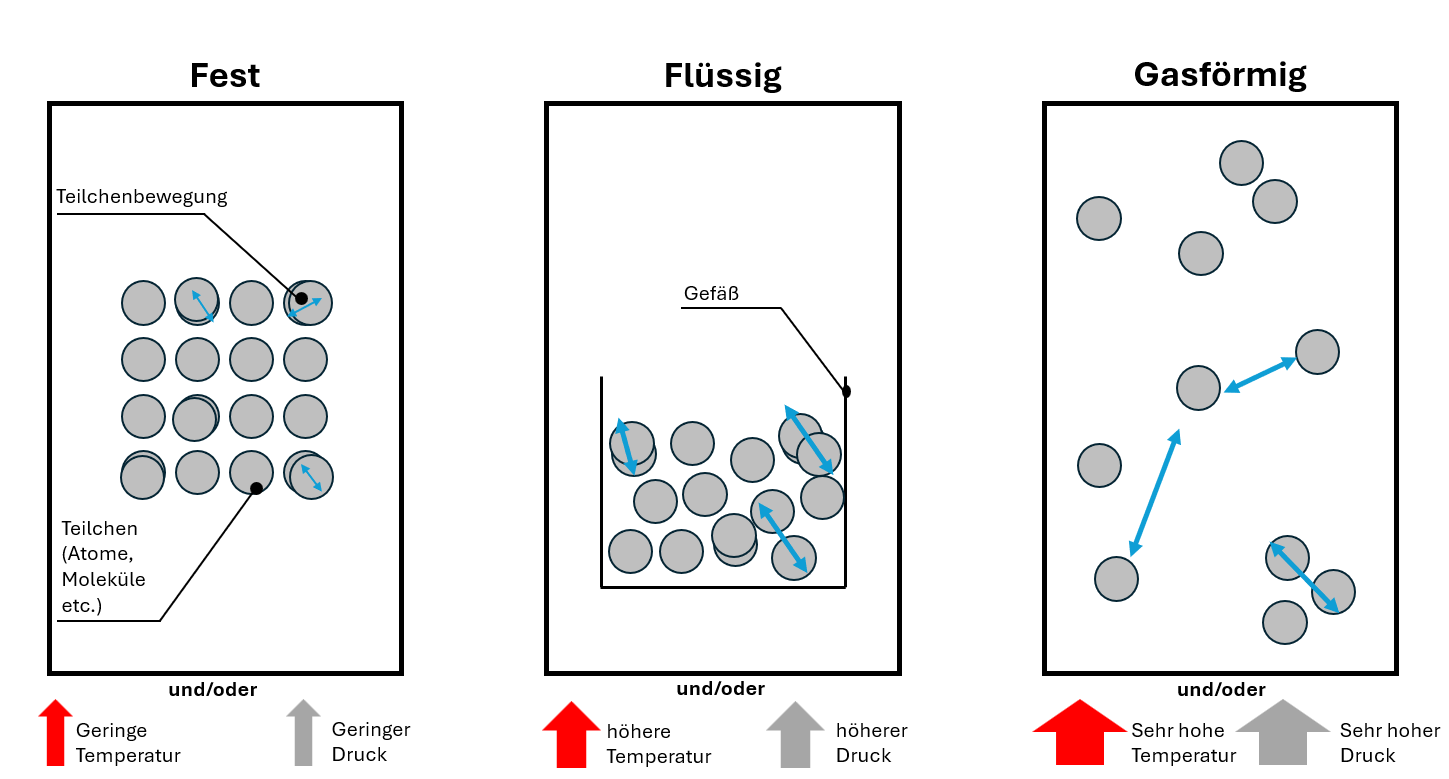
Solid, liquid and gaseous – these three states of matter are ubiquitous. But what exactly is a state of matter?
Definition: The current status or appearance of matter, determined by the movement of particles.
Fundamental law of nature: As temperature rises, particles move faster and more vigorously.
The properties of the three states of matter differ fundamentally:
| State | Particle Movement | Structure |
|---|---|---|
| Solid | Vibrate in place | Ordered structure |
| Liquid | Move, stay connected | Partially ordered |
| Gaseous | Move freely | No structure |
Important: The transition from one state to another requires energy absorption or release. This is precisely what the heat pump exploits!
The Two Laws of Thermodynamics
The science of heat – thermodynamics – has two fundamental rules:
First Law: Conservation of Energy
Energy cannot be created from nothing or destroyed. It can only be converted.
Examples:
- Electrical energy → Heat (electric heater)
- Chemical energy → Heat (fire)
Second Law: Direction of Heat Flow
Heat always moves from hot to cold.
Nature always tries to achieve an energetic equilibrium.
Example fireplace: Heat leaves the hot fireplace and warms the cold room – never the other way round.
The Three Types of Heat Transfer
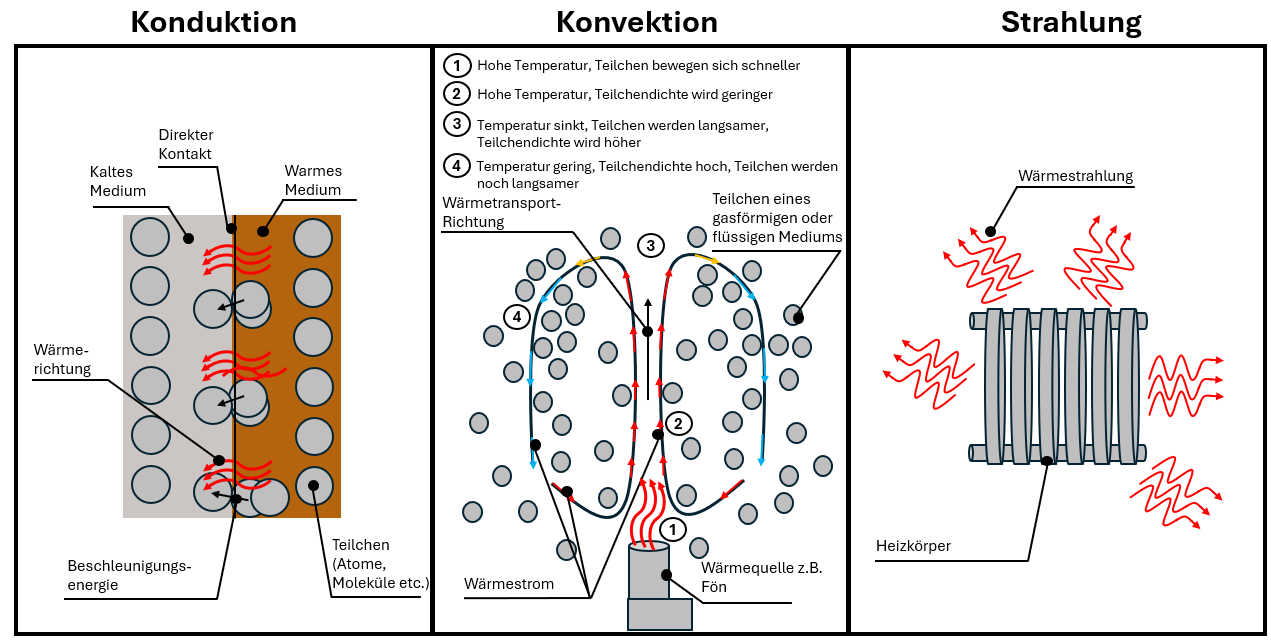
Heat can travel from one place to another in various ways:
| Type | Description | Example |
|---|---|---|
| Conduction | Direct contact of two materials | Hand on radiator |
| Convection | Heat transport by moving gases/liquids | Warm air rises |
| Radiation | Electromagnetic waves | Solar warmth |
Conduction
The fast-moving particles of the warmer material collide with the slower particles of the colder one. This is how heat transfers through direct contact.
Convection
Warm air has lower density and rises. It takes the heat with it and transports it to another location.
Cycle:
- Air is heated → density decreases → rises
- At the top, the air cools → density increases → sinks
- At the bottom, it is heated again → cycle closes
Thermal Radiation
Electromagnetic waves in the infrared range. Needs no transfer medium – that is why solar warmth reaches us through the vacuum of space.
The Operating Principle of the Heat Pump
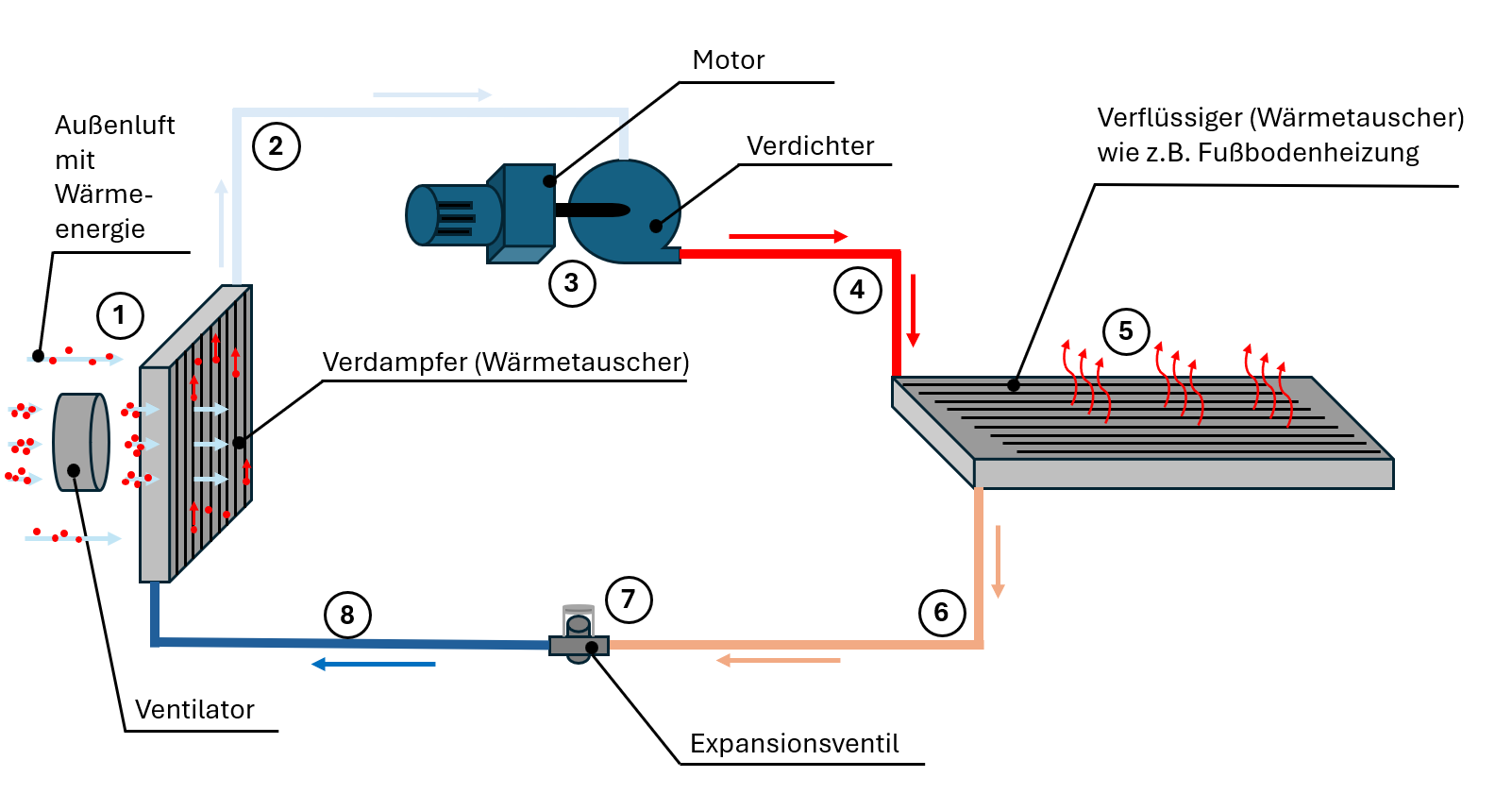
The heat pump "pumps" heat from one place to another – just like a water pump transports water.
The Basic Idea
The heat pump:
- Extracts heat from the environment (even from cold air!)
- Compresses this heat to a higher temperature level
- Releases the heat to the heating system
But How Does One Extract Heat from Cold Air?
The secret lies in the refrigerant – a special liquid that evaporates even at very low temperatures and absorbs heat in the process.
The Cycle in Four Phases
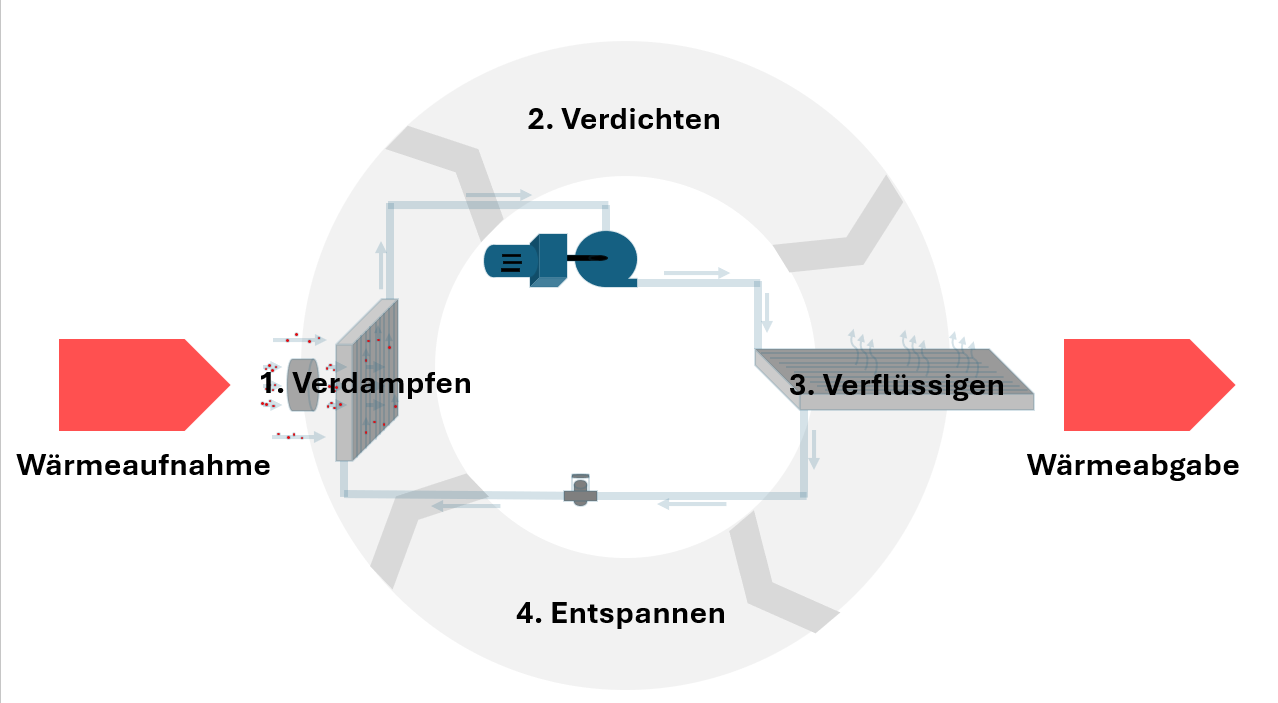
Phase 1: Evaporation (Heat Absorption)
- The liquid refrigerant flows through the evaporator (heat exchanger)
- Ambient air is drawn in by a fan
- Even cold air contains heat energy
- The refrigerant absorbs this heat and evaporates (becomes gaseous)
Phase 2: Compression (Temperature Increase)
- The gaseous refrigerant reaches the compressor
- The compressor mechanically compresses the gas
- Through compression, pressure rises and thus temperature
- The refrigerant now has a usable, high temperature
Phase 3: Condensation (Heat Release)
- The hot, compressed gas flows to the condenser (second heat exchanger)
- The heat is transferred to the heating water
- The refrigerant condenses (becomes liquid again)
- The heated water flows to underfloor heating or radiators
Phase 4: Expansion (Pressure Reduction)
- The liquid refrigerant still has elevated pressure
- The expansion valve releases the pressure
- Pressure drops → temperature drops
- The refrigerant is back to its initial state
Then the cycle starts again!
Summary of the Phases
The four phases of the heat pump cycle can be summarised clearly:
| Phase | Component | Process | State |
|---|---|---|---|
| 1 | Evaporator | Heat absorption | Liquid → Gaseous |
| 2 | Compressor | Pressure increase | Gaseous (hot) |
| 3 | Condenser | Heat release | Gaseous → Liquid |
| 4 | Expansion valve | Pressure reduction | Liquid (cold) |
No Contradiction to Physics!
At first glance, the heat pump seems to violate the second law of thermodynamics: heat flows from cold (outside air) to warm (heating).
The solution: Energy (electricity for the compressor) is used to reverse the natural heat flow. The system as a whole follows the laws of nature!
The Trick
- The refrigerant is colder than the outside air → heat flows in (physically correct)
- Through compression, the refrigerant becomes warmer than the heating water → heat flows out (physically correct)
The heat pump does not create energy from nothing – it only transports and transforms it very cleverly!
Advantages and Disadvantages of Heat Pumps
Advantages
Heat pumps offer numerous advantages over conventional heating systems:
| Advantage | Explanation |
|---|---|
| High efficiency | From 1 kWh electricity you get 3–5 kWh heat |
| Environmentally friendly | No direct CO2 emissions |
| Low operating costs | Cheaper than oil or gas |
| Long lifespan | 15–25 years |
| Low maintenance | No combustion = little wear |
| No fuel storage | No oil tank, no gas connection needed |
| Subsidies | Government grants available |
Disadvantages
Despite the many positive features, there are also aspects to consider:
| Disadvantage | Explanation |
|---|---|
| High purchase costs | €10,000–25,000 depending on type |
| Electricity dependent | Requires electrical power |
| Efficiency drops in cold | Less efficient at very low temperatures |
| Noise | Outdoor unit can be audible |
| Low flow temperatures | Not suitable for all heating systems |
| Space requirement | Outdoor unit or ground works needed |
Conclusion
Core Message: Heat pumps use clever physics to extract heat from the environment and raise it to a usable level. The cycle of evaporation, compression, condensation and expansion makes it possible to extract heating warmth even from cold winter air.
Which components work together exactly, you will learn in the article The Components: Heat Exchanger, Compressor and Expansion Valve.
Article Series
| No. | Article | Topic |
|---|---|---|
| 1 | Heat Pump: The Complete Guide | Overview and introduction |
| 2 | How does a heat pump work? | You are here |
| 3 | The Components | Heat exchanger, compressor, expansion valve |
| 4 | Key Figures and Sizing | COP, SPF, sizing |
| 5 | Operating Modes | Monovalent, bivalent, hybrid |
| 6 | Heat Pump Types and Solar Integration | Types & PV combination |
| 7 | SCOP Explained | Seasonal performance factor |
| 8 | Optimisation & Settings | Practical operating guide |
| 9 | Calculate Output | Sizing |
| 10 | Heat Pump Costs 2026 | Purchase, installation, operation |
| 11 | Heat Pump in Old Buildings | Efficient use in existing stock |
| 12 | Electricity Consumption per Year | Consumption by building type |
| 13 | Save Heating Costs with a Heat Pump | Cost comparison gas/oil/HP |
| 14 | Solar and Heat Pump: The Dream Team | PV + HP combination |
| 15 | Heat Pump Subsidies 2026 | Subsidies & applications |
Sources
- DESTATIS: Heat Pumps in New Buildings 2023
- Mordor Intelligence: Heat Pumps Market
- Heizung.de: History of the Heat Pump
- LEIFIphysik: Heat Transport
- Chemie.de: Thermodynamics
Calculate SPF Now
With our free Heat Pump Calculator, you can calculate the seasonal performance factor of your heat pump according to VDI 4650 – including operating costs and CO₂ balance.