


Heat Pump Electricity Consumption per Year: Calculate, Understand and Reduce Your Usage
An air-to-water heat pump in a typical detached house consumes between 3,000 and 6,000 kWh of electricity per year. At a heat pump electricity tariff of 0.27 EUR/kWh, that equates to annual running costs of EUR 800 to 1,600. The range is enormous -- a passive house manages with just 500 kWh, whilst an uninsulated older building can require over 10,000 kWh.
Electricity consumption is the key factor determining whether a heat pump is economically viable. It decides whether the investment pays for itself in 6 years or 15. This article explains what factors determine consumption, how different building types and heating systems affect it, and where the greatest savings potential lies.
The Basic Formula -- From Heat Demand to Electricity Consumption
A heat pump's electricity consumption can be calculated with a single formula:
Electricity consumption (kWh/a) = Heat demand (kWh/a) / SPF
The heat demand is the amount of energy the building requires per year for space heating and hot water. The Seasonal Performance Factor (SPF) describes how efficiently the heat pump produces this heat -- an SPF of 3.5 means: 1 kWh of electricity generates 3.5 kWh of heat.
A concrete example: A detached house of 150 m² with an annual heat demand of 15,000 kWh is heated by an air-to-water heat pump achieving an SPF of 3.5.
15,000 kWh / 3.5 = 4,286 kWh electricity consumption per year
At a heat pump electricity tariff of 0.27 EUR/kWh, the annual cost is EUR 1,157. With standard household electricity (0.36 EUR/kWh) it would be EUR 1,543, and with photovoltaic self-consumption (0.10 EUR/kWh) only EUR 429.
What Determines Heat Demand?
A building's heat demand depends primarily on four factors. The building envelope is the most important: U-values of walls, windows, roof and basement ceiling determine the transmission heat losses. A window with a U-value of 0.9 W/(m²·K) loses only a third of the heat of an old window with a U-value of 2.8. In addition, floor area and building geometry play a role -- a detached house has more external wall area than a terraced house of the same size. The climate zone also matters: in Munich (design outdoor temperature -16 °C) the heat demand is higher than in Cologne (-10 °C). Finally, occupant behaviour significantly influences consumption -- every degree higher room temperature increases heat demand by around 6%.
If you do not know your building's heat demand, you can derive it from your previous energy consumption: for a gas boiler, the annual consumption in kWh roughly equals the heat demand. For oil heating, the rule is: litres x 10 = kWh. A more precise result comes from a heat load calculation to DIN EN 12831 -- for example, using our heat load calculator.
What Determines the SPF?
The Seasonal Performance Factor is not a fixed property of the heat pump, but the result of the appliance, heat source, heating system and settings. The heat source has the greatest influence: groundwater provides 8-12 °C year-round, ground source 0-10 °C, whilst outdoor air fluctuates between -15 and +35 °C. The warmer the source, the less work for the compressor, and the higher the SPF.
The second most important factor is the flow temperature of the heating system -- and thus the type of heat distribution. Underfloor heating with a 35 °C flow temperature enables an SPF of 4.0 or higher; old column radiators at 65 °C push the SPF down to 2.0-2.5. Correct sizing of the heat pump and operating settings (heating curve, hot water temperature, room thermostats) also play a role. More details in the articles SCOP Explained and Optimisation & Settings.
Electricity Consumption by Building Type -- The Comprehensive Overview Table
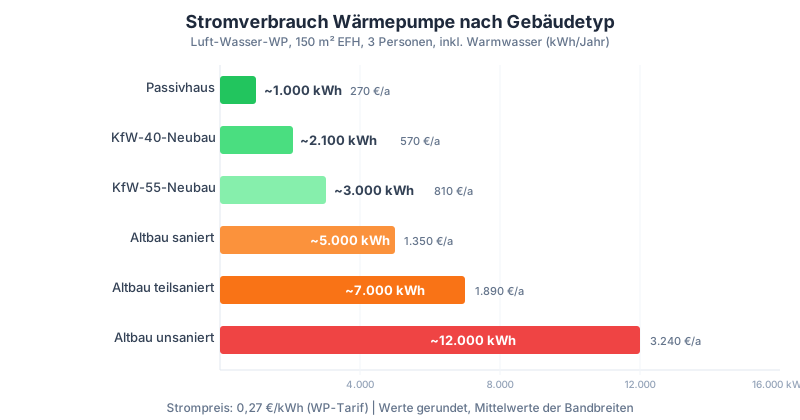
The following table shows the typical electricity consumption of an air-to-water heat pump for a detached house with 150 m² of living space -- broken down by building standard. The figures include heating and hot water for a 3-person household.
| Building type | Heat demand (kWh/m²·a) | Total heat demand (kWh/a) | Typical SPF | Electricity consumption (kWh/a) | Electricity cost (EUR/a) |
|---|---|---|---|---|---|
| Passive house (≤ 15 kWh/m²) | 15 | 4,650 | 4.5-5.0 | 930-1,030 | 250-280 |
| KfW 40 new build | 25-40 | 6,150-8,400 | 4.0-4.5 | 1,370-2,100 | 370-570 |
| KfW 55 new build | 55 | 10,650 | 3.5-4.0 | 2,660-3,040 | 720-820 |
| Renovated older building (EnEV / from 1995) | 80-100 | 14,400-17,400 | 3.0-3.5 | 4,110-5,800 | 1,110-1,570 |
| Partially renovated older building | 100-130 | 17,400-21,900 | 2.8-3.2 | 5,440-7,820 | 1,470-2,110 |
| Uninsulated older building (pre-1977) | 150-250 | 24,900-39,900 | 2.5-3.0 | 8,300-15,960 | 2,240-4,310 |
Assumptions: Air-to-water heat pump, 150 m², 3 persons, hot water 2,400 kWh thermal, heat pump electricity tariff 0.27 EUR/kWh
The ranges arise from differing boundary conditions: climate zone, window-to-wall ratio, number of storeys, compactness of the floor plan, and whether the heat pump operates with underfloor heating or radiators.
Double burden in uninsulated older buildings: In poorly insulated buildings, two factors compound -- the heat demand is three to five times higher than in a new build, and at the same time the high flow temperatures force a low SPF. An uninsulated older building therefore requires up to 15 times more electricity than a passive house. Before installing a heat pump, it is almost always worthwhile to at least partially upgrade the building envelope.
The Heat Distribution Factor -- Radiators, Surface Heating and Their Impact on Consumption
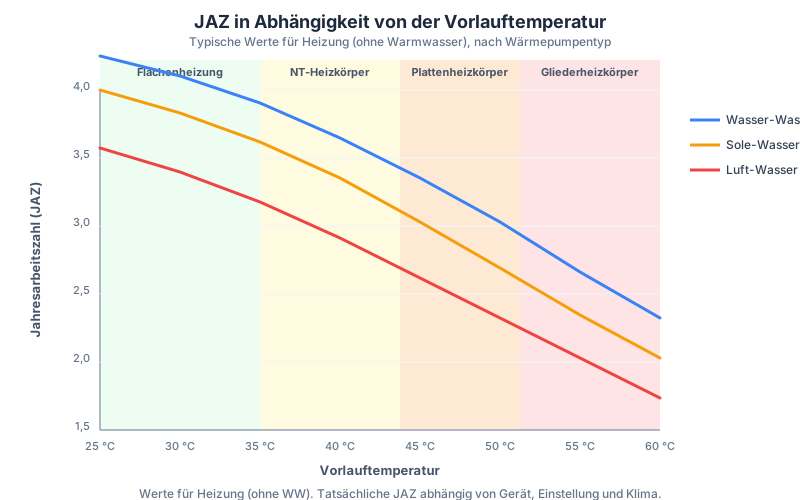
Heat distribution within the building is the second most important factor influencing electricity consumption after the building envelope. The causal chain is clear: the type of heating surface determines the required flow temperature -- the flow temperature determines the SPF -- the SPF determines electricity consumption. As a rule of thumb: every kelvin reduction in flow temperature saves around 2.5% electricity. A reduction of 10 K therefore means 25% less consumption.
Surface Heating Systems -- The Optimum
Underfloor, wall and ceiling heating systems share a common characteristic: they use large surfaces for heat transfer and therefore require low flow temperatures. Underfloor heating in a new build typically operates at 28-35 °C, wall heating at 30-38 °C. At these temperatures, an air-to-water heat pump achieves an SPF of 4.0 to 5.5.
The high proportion of radiant heat additionally ensures a more uniform temperature distribution in the room. Unlike convective heat, which first warms the air at the ceiling, radiant heat directly warms objects and people. This allows a room temperature 1-2 °C lower with the same comfort level -- saving additional energy.
Concrete example: A KfW 55 new build with 150 m², underfloor heating and an air-to-water heat pump. The heat demand is 10,650 kWh/a (heating + hot water). With an SPF of 4.2, this results in electricity consumption of 2,536 kWh/a, equating to costs of around EUR 685.
Radiator Types in Detail
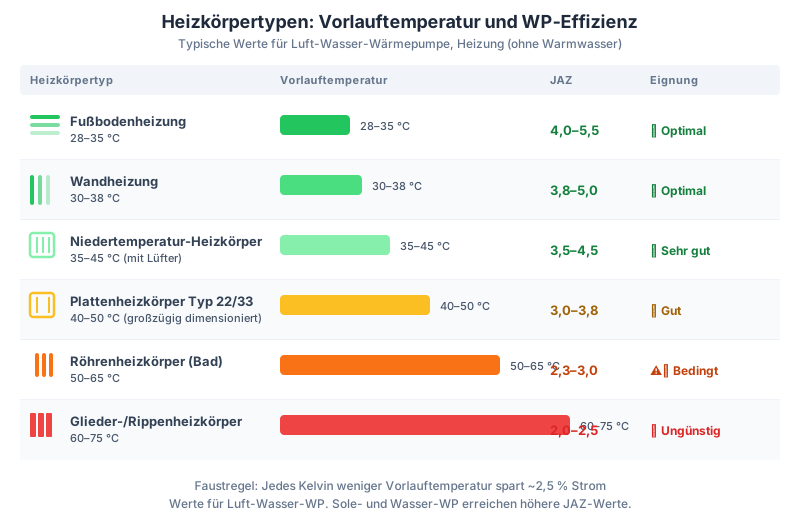
Not all radiators are equal. Differences in construction, size and heat transfer directly affect the required flow temperature and consequently heat pump electricity consumption.
| Radiator type | Flow temperature | Heat output | Heat pump suitability | SPF range |
|---|---|---|---|---|
| Low-temperature radiators | 35-45 °C | Radiation + convection, some with fan | Optimal | 3.5-4.5 |
| Panel radiators Type 22/33 (generously sized) | 40-50 °C | High radiant proportion | Well suited | 3.0-3.8 |
| Fan convectors (fan coils) | 35-45 °C | Convection with fan assistance | Well suited, but audible | 3.5-4.2 |
| Panel radiators (standard sized) | 50-60 °C | Radiation + convection | Conditionally suitable | 2.5-3.2 |
| Towel radiators (bathrooms etc.) | 50-65 °C | Predominantly convection | Conditionally suitable | 2.3-3.0 |
| Column/ribbed radiators | 60-75 °C | Predominantly convection | Unfavourable | 2.0-2.5 |
Low-temperature radiators (also known as heat pump radiators) are specifically designed for operation at low flow temperatures. They combine large heating surfaces with an additional aluminium-copper heat exchanger that increases heat output by 30-50% at the same physical size. Some models feature an integrated fan that activates when needed -- lowering the required flow temperature by a further 5-10 K.
Panel radiators are widely used in renovated buildings. Sizing is crucial: a generously dimensioned Type 33 radiator (three panels, three convection fins) delivers significantly more heat at 45 °C flow temperature than a compact Type 11. After building renovation, existing panel radiators are often oversized because the heat demand has decreased -- they then work well with lower flow temperatures too.
Fan convectors are an interesting alternative for older buildings. With active air circulation, they achieve high heat outputs at low flow temperatures. The downside: they require an electrical connection and produce a quiet fan noise (comparable to a quiet refrigerator).
Column and ribbed radiators made of cast iron were standard until the 1970s. Their small surface area forces high flow temperatures -- but only if the room's heat demand remains unchanged. After facade insulation, the required heating output can drop so significantly that even these old radiators manage with 50 °C.
Practical flow temperature test: Lower the flow temperature of your existing heating system to 45 °C on a trial basis -- ideally during a cold spell in winter. If all rooms reach a comfortable temperature within 2-3 hours, your radiators are suitable for heat pump operation. Individual rooms that remain cool can be selectively upgraded with larger radiators.
Practical Example -- Same Heat Demand, Different Heat Distribution
The following comparison shows how dramatically heat distribution affects electricity consumption -- for an identical building with 15,000 kWh heat demand and an air-to-water heat pump:
| Heat distribution | Flow temperature | SPF | Electricity consumption | Electricity cost | Additional cost vs. UFH |
|---|---|---|---|---|---|
| Underfloor heating | 35 °C | 4.0 | 3,750 kWh | EUR 1,013 | Reference |
| Low-temperature radiators | 45 °C | 3.4 | 4,412 kWh | EUR 1,191 | +EUR 178/a |
| Panel radiators (generous) | 50 °C | 3.0 | 5,000 kWh | EUR 1,350 | +EUR 337/a |
| Column radiators (old) | 65 °C | 2.3 | 6,522 kWh | EUR 1,761 | +EUR 748/a |
Over 20 years, the difference between underfloor heating and old column radiators amounts to nearly EUR 15,000 -- more than the cost of replacing the radiators. Anyone planning a heat pump with old radiators should therefore upgrade at least the rooms with the highest heat demand (living room, bathroom) with larger low-temperature radiators.
Hot Water -- The Underestimated Energy Drain
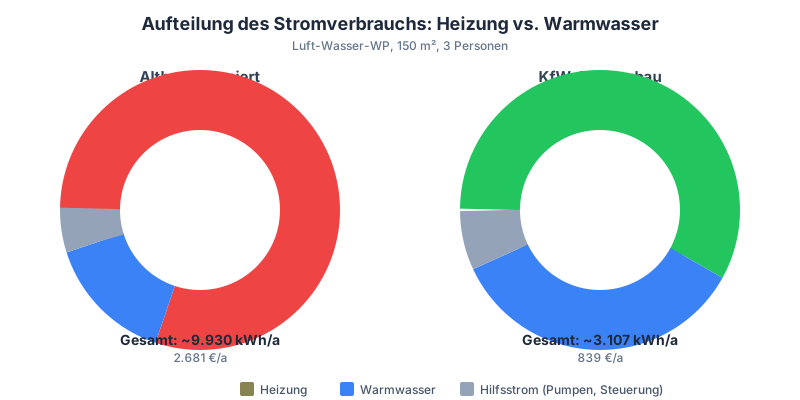
Hot water preparation is frequently underestimated when assessing consumption. Whilst its percentage share is moderate in poorly insulated buildings (15-20% of total consumption), it dominates in well-insulated houses: in a KfW 55 new build, 30-40% of the heat pump's electricity consumption goes to hot water, and in a passive house up to 50%.
The reason lies in physics: hot water must be heated to at least 45-50 °C regardless of insulation standard. The heat pump therefore operates at lower efficiency for hot water than for space heating. Whilst the SPF for space heating with underfloor heating can be 4.0 or more, it typically sits at 2.5-3.0 for hot water.
Hot Water Energy Demand per Person
Each person uses approximately 40 litres of hot water per day. To heat this from 10 °C cold water temperature to 45 °C requires around 1.6 kWh of thermal energy per day -- that is approximately 600 kWh per person per year for hot water alone (excluding storage and distribution losses). Including losses, the figure is approximately 800 kWh per person per year.
| Household size | Thermal HW demand (kWh/a) | Electricity at SPF 2.8 (kWh/a) | Electricity cost (0.27 EUR/kWh) |
|---|---|---|---|
| 1 person | 800 | 286 | EUR 77 |
| 2 persons | 1,600 | 571 | EUR 154 |
| 3 persons | 2,400 | 857 | EUR 231 |
| 4 persons | 3,200 | 1,143 | EUR 309 |
Legionella Protection -- Necessary but Energy-Intensive
Legionella are bacteria that multiply in stagnant hot water between 25 and 50 °C. In multi-family buildings and larger systems, the DVGW directive requires regular thermal disinfection: the water in the tank must be periodically heated to at least 60 °C. In single-family houses there is no legal obligation, but most manufacturers recommend a weekly legionella cycle.
The problem: at a 60 °C storage temperature, the heat pump's COP drops to 2.0-2.5. Many systems activate the electric immersion heater for this purpose, which operates at a COP of 1.0 -- a pure energy drain. The additional consumption from the legionella cycle amounts to 48-96 kWh per year.
The more efficient strategy: store hot water at 48 °C in normal operation and heat to 60 °C just once weekly for 30 minutes. This saves around 15-20% of hot water electricity compared to a constant storage temperature of 55 °C.
Three Practical Examples Calculated in Detail
Theory is valuable, but concrete figures are more useful. The following three scenarios cover the most common situations -- from the ideal case to the challenging older building.
Example 1: KfW 55 New Build with Underfloor Heating
The ideal scenario for a heat pump: good insulation and low flow temperatures.
- Building: 150 m², year of construction 2025, KfW 55
- Occupants: 4 persons
- Heat pump: Air-to-water, 8 kW
| Item | Heat demand | SPF | Electricity consumption |
|---|---|---|---|
| Space heating | 8,250 kWh | 4.2 | 1,964 kWh |
| Hot water | 3,200 kWh | 2.8 | 1,143 kWh |
| Total | 11,450 kWh | 3.7 (weighted) | 3,107 kWh |
Electricity cost: EUR 839/a (heat pump tariff 0.27 EUR/kWh) | With PV self-consumption (40%): EUR 565/a
Example 2: Renovated Older Building with Panel Radiators
The reality for many homeowners switching from gas to a heat pump: the building envelope has been improved, but the radiators remain.
- Building: 160 m², year of construction 1985, facade insulated, new windows
- Occupants: 3 persons
- Heat pump: Air-to-water, 10 kW
- Flow temperature: 50 °C (panel radiators adequately sized)
| Item | Heat demand | SPF | Electricity consumption |
|---|---|---|---|
| Space heating | 14,400 kWh | 3.0 | 4,800 kWh |
| Hot water | 2,400 kWh | 2.5 | 960 kWh |
| Total | 16,800 kWh | 2.9 (weighted) | 5,760 kWh |
Electricity cost: EUR 1,555/a (heat pump tariff) | Comparison with old gas boiler: ~EUR 1,850/a --> Savings EUR 295/a
Example 3: Uninsulated Older Building with Column Radiators
The most demanding scenario -- this reveals whether a heat pump is the right choice.
- Building: 140 m², year of construction 1968, no insulation, single glazing partially replaced
- Occupants: 2 persons
- Heat pump: Air-to-water, 14 kW
- Flow temperature: 65 °C (old column radiators)
| Item | Heat demand | SPF | Electricity consumption |
|---|---|---|---|
| Space heating | 21,000 kWh | 2.3 | 9,130 kWh |
| Hot water | 1,600 kWh | 2.0 | 800 kWh |
| Total | 22,600 kWh | 2.3 (weighted) | 9,930 kWh |
Electricity cost: EUR 2,681/a (heat pump tariff) | Comparison with old gas boiler: ~EUR 2,500/a --> no cost advantage
Caution: In this scenario, the heat pump is not economically viable compared to gas. Two measures fundamentally change the picture: facade insulation reduces the heat demand to ~12,000 kWh, and replacing the radiators enables a 45 °C flow temperature. Together, electricity consumption drops to ~3,800 kWh (EUR 1,026/a). Alternatively, a hybrid system with a gas peak-load boiler is an option.
Correct Sizing -- The Greatest Lever
An incorrectly sized heat pump systematically consumes too much electricity. This applies in both directions:
Undersizing means the heat pump cannot meet the required heating output on cold days on its own. In this case, the electric immersion heater kicks in -- at a COP of 1.0 instead of 3-4. Even if the immersion heater only runs on a few days per year, it increases total consumption by 8-15%, because these cold days have the highest heat demand.
Oversizing causes a different problem: short-cycling. The heat pump frequently switches on and off because it delivers the required heat too quickly. Every start-stop cycle is inefficient (start-up losses, defrost cycles for air-source heat pumps), and the frequent switching increases compressor wear. Modern inverter heat pumps can modulate their output down, but they too have a minimum output below which they cannot operate.
| Sizing | Impact | Additional electricity consumption |
|---|---|---|
| Correct (95-105% of heat load) | Long run times, little short-cycling, optimal SPF | Reference |
| 20% undersized | Immersion heater operation on 10-30 days/year | +8-15% |
| 30% oversized | Frequent short-cycling (3-12 starts/hour) | +10-15% |
Rule of thumb: The correct heat pump output is derived from the building's heat load to DIN EN 12831 plus an allowance for hot water. Rules of thumb or rough estimates frequently lead to incorrect sizing. Details on the calculation can be found in the article Calculating Heat Pump Output.
Electricity Consumption by Heat Pump Type
For the same building and the same heating system, the three heat pump types differ in electricity consumption -- the cause is the different source temperature.
| HP type | Heat source | Source temperature (winter) | Typical SPF | Electricity consumption* | Electricity cost* |
|---|---|---|---|---|---|
| Air-to-water | Outdoor air | -10 to +7 °C | 3.0-3.5 | 4,285-5,000 kWh | EUR 1,157-1,350 |
| Brine-to-water | Ground | 0 to +5 °C | 3.8-4.5 | 3,333-3,947 kWh | EUR 900-1,066 |
| Water-to-water | Groundwater | +8 to +12 °C | 4.5-5.5 | 2,727-3,333 kWh | EUR 736-900 |
Basis: 15,000 kWh heat demand, heat pump electricity tariff 0.27 EUR/kWh
The air-to-water heat pump has the highest electricity consumption because outdoor air is coldest in winter -- precisely when heat demand is greatest. The compressor must overcome a larger temperature lift. Additionally, defrost cycles on frosty days consume extra energy. Ground source and groundwater heat pumps benefit from more stable source temperatures and therefore achieve higher efficiency year-round.
Nevertheless, around 85% of buyers choose air-to-water heat pumps -- due to significantly lower investment costs (no borehole, no permit). The additional electricity costs of EUR 200-400 per year are put into perspective against the EUR 10,000-20,000 higher purchase costs for a ground source or groundwater system. More on costs in the article Heat Pump Costs 2026.
Reducing Electricity Consumption -- The Key Levers
To reduce heat pump electricity consumption, you need to focus on the right measures. The following overview shows the measures with the greatest impact -- ordered by savings potential.
| Measure | Savings | Electricity saved (based on 5,000 kWh) | Cost of measure |
|---|---|---|---|
| Reduce flow temperature by 5 K | 10-12% | 500-600 kWh | EUR 0 (settings) |
| Hydraulic balancing (Method B) | ~13% | ~650 kWh | EUR 400-800 |
| Deactivate room thermostats, use heating curve | up to 17% SPF gain | up to 850 kWh | EUR 0 (settings) |
| HW temperature to 48 °C (1x weekly 60 °C) | 15-20% of HW share | 150-250 kWh | EUR 0 (settings) |
| Photovoltaics (30-50% self-consumption coverage) | Costs -40 to -60% | kWh unchanged, costs decrease | EUR 8,000-14,000 |
| Night setback (only for poorly insulated buildings) | 3-8% | 150-400 kWh | EUR 0 (settings) |
The cost-free settings adjustments should always be implemented first. Simply by reducing the flow temperature and deactivating room thermostats, EUR 200-400 per year can be saved. Detailed instructions for all optimisation measures can be found in the article Optimisation & Settings.
Frequently Asked Questions
How much electricity does a heat pump use in a detached house?
On average, 3,000 to 6,000 kWh per year. In a well-insulated new build with underfloor heating, the figure is closer to 2,000-3,000 kWh; in an older house with conventional radiators, 5,000-8,000 kWh. According to the Heizspiegel 2024 (German heating cost index), the average is 35-39 kWh per square metre of living space.
What does the electricity for a heat pump cost per year?
At a heat pump electricity tariff of 0.27 EUR/kWh, annual electricity costs range between EUR 800 and 1,600 for a typical detached house. With photovoltaic self-consumption, costs drop to EUR 400-800. For comparison: a gas boiler costs approximately EUR 1,800-2,400/a at the current gas price (0.12 EUR/kWh including CO2 levy).
Is heat pump electricity consumption too high in older buildings?
Not necessarily. In renovated older buildings with appropriately sized radiators and 45-50 °C flow temperatures, heat pumps achieve an SPF of 3.0-3.5 and consume 4,000-5,500 kWh. It only becomes problematic in uninsulated buildings with flow temperatures above 55 °C. In such cases, partial renovation or a hybrid system is worthwhile. Details in the article Heat Pumps in Older Buildings.
Can a heat pump operate efficiently with radiators?
Yes, provided the flow temperature stays below 50 °C. Modern panel radiators (Type 22 or 33) of adequate size often manage with 45 °C. Specialist low-temperature or heat pump radiators achieve this even at 35-40 °C. Only old column and ribbed radiators requiring 60-70 °C are critical -- these should be replaced before heat pump installation.
How do I calculate my heat pump's electricity consumption?
Using the formula: Electricity consumption = Heat demand / SPF. You can derive the heat demand from your previous gas consumption (in kWh, from your energy supplier) or oil consumption (litres x 10). The SPF depends on the heat pump type and flow temperature. Our heat pump calculator determines the SPF according to VDI 4650 for your individual situation.
Is a photovoltaic system worthwhile for a heat pump?
Economically, almost always: PV self-consumption costs 8-12 cents/kWh instead of 27-36 cents for grid electricity. Realistically, 30-50% of heat pump electricity can be covered by self-consumption, reducing annual costs by EUR 300-600. The combination pays for itself faster than either technology alone.
Conclusion -- What Really Determines Electricity Consumption
In summary: A heat pump's electricity consumption is dominated by two factors: the building's heat demand and the efficiency at which the heat pump operates. The building envelope and the type of heat distribution have more influence than the heat pump type itself. A well-insulated house with underfloor heating uses less electricity with an air-to-water heat pump than an uninsulated older building with a more expensive ground source heat pump. Correct sizing to DIN EN 12831 is essential -- both oversizing and undersizing cost 10-15% in efficiency. Those planning with radiators rather than underfloor heating need not compromise on comfort, provided the flow temperature stays below 50 °C. And the hot water share becomes increasingly significant with better insulation standards -- in a passive house, half of electricity consumption goes to hot water. Combining with photovoltaics does not reduce consumption, but lowers costs by 40-60%.
Article Series
| No. | Article | Topic |
|---|---|---|
| 1 | Heat Pumps: The Complete Guide | Overview and introduction |
| 2 | How Does a Heat Pump Work? | Physical fundamentals |
| 3 | The Components | Heat exchangers, compressor, expansion valve |
| 4 | Key Figures and Sizing | COP, SPF, design |
| 5 | Operating Modes | Monovalent, bivalent, hybrid |
| 6 | Heat Pump Types and Solar Integration | Types & combination with PV |
| 7 | SCOP Explained | Seasonal coefficient of performance |
| 8 | Optimisation & Settings | Practical operating guide |
| 9 | Calculating Output | Sizing |
| 10 | Heat Pump Costs 2026 | Purchase, installation, operation |
| 11 | Heat Pumps in Older Buildings | Efficient use in existing stock |
| 12 | Electricity Consumption per Year | You are here |
| 13 | Save on Heating with a Heat Pump | Cost comparison gas/oil/HP |
| 14 | Solar and Heat Pump: The Dream Team | PV + HP combination |
| 15 | Heat Pump Subsidies 2026 | Subsidies & applications |
Sources
- co2online: Stromverbrauch von Wärmepumpen
- Vattenfall: Wärmepumpe Stromverbrauch
- Heizspiegel 2024: Verbrauchskennwerte Wärmepumpen
- Viessmann: Vorlauftemperatur und Effizienz
- BWP: Wärmepumpen-Branchenstatistik 2025
- ENERGIE-FACHBERATER: Niedertemperatur-Heizkörper
- Thermondo: Stromverbrauch Wärmepumpe berechnen
Calculate Consumption & Size Your Heat Pump
Use our free calculators to determine your building's heat demand and the right heat pump size -- compliant with DIN EN 12831 and VDI 4650.