

Heat pumps in older homes: requirements, solutions & costs
In countries like the United Kingdom and Ireland, a large share of the housing stock was built before modern thermal regulations came into force (for example, before the first UK Building Regulations Part L in 1985 or Ireland’s first energy-related building regulations in the late 1970s). These older buildings are responsible for high heating costs and are central to the energy transition. The question many owners ask is: Can a heat pump work in an uninsulated or only partially renovated older home at all?
The answer is nuanced: yes, a heat pump can work in an older building – but it is not always the most economical solution. Modern high‑temperature heat pumps can deliver flow temperatures up to about 70–75 °C, but that does not automatically mean good efficiency. This article explains honestly and without glossing over the drawbacks when a heat pump in an older property makes sense, what preparations are needed, and which alternatives exist.
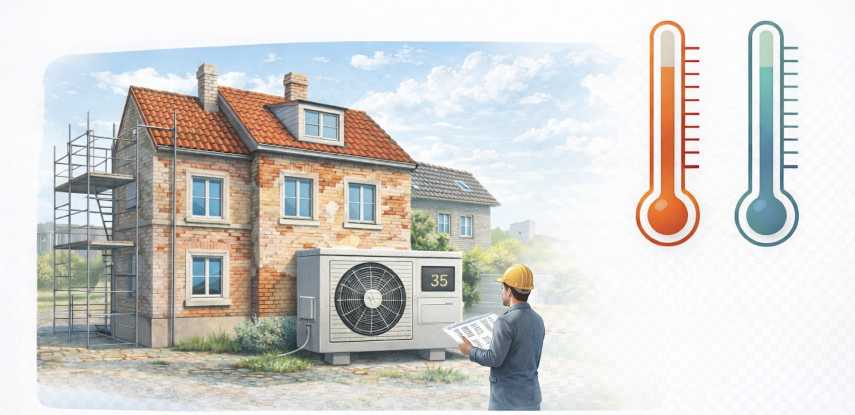
What counts as an “older building” for heat pumps?
“Older building” is not a precise technical term. In the context of heat pumps, it is useful to distinguish by energy standard and construction period:
| Era | Approx. construction years (UK/IE context) | Typical features | Heating load (W/m²) | Energy use (space heating) |
|---|---|---|---|---|
| Victorian / Edwardian / pre‑war | 1870–1939 | Solid brick or stone walls (often 225–450 mm, uninsulated), single glazing or early double glazing, high ceilings, suspended timber floors | 100–150 | 200–300 kWh/m²·a |
| Post‑war to pre‑regulation | 1945–1979 | Cavity walls (often uninsulated), simple double glazing or single glazing, concrete floors, little or no roof/loft insulation | 80–120 | 150–250 kWh/m²·a |
| Early regulation era | 1980–2002 | Basic insulation to walls/loft, double glazing, some cavity wall insulation, first energy standards (e.g. early Part L in UK, early Irish Building Regulations) | 60–90 | 100–150 kWh/m²·a |
| Post‑EPBD / modern standards | 2003–2014 | Modern insulation, double/triple glazing, airtightness measures, often already upgraded | 40–60 | 70–120 kWh/m²·a |
Rule of thumb: The older and less insulated the building, the higher the required flow temperature – and the lower the efficiency of the heat pump. The point where it usually becomes uneconomic is at seasonal performance factors (SPF / SCOP) below about 2.5.
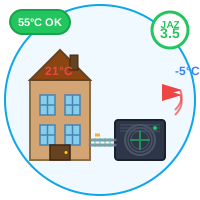
The decisive test: the 55‑degree check
Before you start collecting quotes or commissioning an energy assessor, carry out this simple test. In 24 hours it will show whether your older home is fundamentally suitable for a heat pump.
Step‑by‑step guide
Preparation:
- Choose a very cold day (ideally -5 °C to -10 °C outside, or as cold as your local climate allows)
- Access to your boiler controls (to limit the flow temperature)
Procedure:
| Step | Action | What happens |
|---|---|---|
| 1 | Limit the flow temperature to 55 °C | Set this limit in the boiler/heating controller |
| 2 | Turn all radiator valves fully open | Maximum flow through all radiators |
| 3 | Wait 24 hours | Let the system stabilise |
| 4 | Measure room temperatures in all rooms | With a thermometer or room thermostat |
Interpreting the results:
| Measurement | Meaning | Action |
|---|---|---|
| ✅ Everywhere 20–21 °C or warmer | Building is suitable for a heat pump | Direct installation possible, no major fabric upgrade strictly necessary |
| ⚠️ Some rooms slightly cool (18–19 °C) | Individual radiators undersized | Replace selected radiators with low‑temperature models or add emitters |
| ❌ Everywhere clearly too cold (< 18 °C) | High flow temperature required | Fabric upgrade or a hybrid system recommended |
Alternative if you cannot wait for a very cold day: Use our heating load calculator to estimate the required heat output. If the design flow temperature needs to be above about 55 °C, a straightforward heat pump solution becomes challenging.
In the UK and Ireland, professional heating load calculations are typically based on EN 12831 (implemented via CIBSE and MCS methods) rather than the German DIN EN 12831 variant, but the principle is the same.
Why flow temperature matters so much
Flow temperature is the key factor for heat pump efficiency. The physics behind it: the theoretical (Carnot) efficiency falls as the temperature difference between the heat source (air, ground) and the heating flow increases.
Efficiency at different flow temperatures
| Flow temperature | Heating system | COP (A2/W) | Realistic SPF (SCOP) | Assessment |
|---|---|---|---|---|
| 30–35 °C | Underfloor heating (new build) | 5.0–5.5 | 4.5–5.0 | ✅ Optimal |
| 40–45 °C | Underfloor (retrofit), low‑temp radiators | 4.0–4.5 | 3.5–4.0 | ✅ Very good |
| 50–55 °C | Standard radiators (well sized) | 3.2–3.8 | 2.8–3.3 | ⚠️ Acceptable |
| 60–65 °C | Old cast‑iron radiators | 2.5–3.0 | 2.2–2.6 | ⚠️ Borderline |
| 70–75 °C | High‑temperature heat pump (extreme cases) | 2.0–2.5 | 1.8–2.2 | ❌ Uneconomic |
What this means for running costs:
Assume a typical house needs 15,000 kWh of heat per year:
| Flow temperature | SPF | Electricity use | Cost at £0.30/kWh |
|---|---|---|---|
| 35 °C | 4.5 | 3,333 kWh | ~£1,000 |
| 45 °C | 3.5 | 4,286 kWh | ~£1,285 |
| 55 °C | 2.8 | 5,357 kWh | ~£1,610 |
| 65 °C | 2.2 | 6,818 kWh | ~£2,045 |
Every 10 K increase in flow temperature adds roughly £250–£350 per year in electricity costs at current UK/Irish tariffs.
Modern high‑temperature heat pumps: solution or marketing?
Manufacturers increasingly promote high‑temperature heat pumps that can reach 70–75 °C flow temperature. That sounds like the perfect answer for any older property – but be cautious:
Advantages:
- No need to change existing radiators
- Works even in uninsulated older buildings
- Often easier in listed buildings where internal changes are limited
Disadvantages:
- Seasonal performance factors often only 2.0–2.5 (barely better than a modern gas boiler on cost)
- Higher upfront cost
- Running costs close to gas at current UK/Irish price ratios
Critical assessment: With electricity at around £0.30/kWh and gas at around £0.10/kWh, a high‑temperature heat pump with SPF 2.3 is roughly cost‑neutral compared with a condensing gas boiler (break‑even COP/SPF ≈ 2.8–3.0, depending on boiler efficiency). The carbon benefit remains, but the financial advantage is small.
Assessing the building: where you stand now
Before deciding, you need a clear picture of the current situation. This checklist helps:
Older‑home checklist
Basic data:
- [ ] Year of construction: _____
- [ ] Heated floor area: ____ m²
- [ ] Number of occupants: ____
Energy use:
- [ ] Energy Performance Certificate (EPC) available? (UK/IE)
- [ ] Current annual fuel use: ____ kWh or ____ litres oil / m³ gas
- [ ] Specific heat use: ____ kWh/m²·a (total kWh divided by floor area)
Heating system:
- [ ] Current system: Gas / Oil / Direct electric / District heating
- [ ] Boiler age: ____
- [ ] Boiler output: ____ kW
- [ ] Emitters: Cast‑iron radiators / Panel radiators / Convectors / Underfloor heating
Building fabric:
- [ ] External walls insulated: Yes / No (if yes: type & thickness: ____, year: ____)
- [ ] Loft/attic insulated: Yes / No (if yes: thickness: ____ cm, year: ____)
- [ ] Ground floor or basement ceiling insulated: Yes / No (if yes: thickness: ____ cm, year: ____)
- [ ] Windows: Single / Early double / Modern double / Triple (installation year: ____)
Space and layout:
- [ ] Space for outdoor unit (at least 1 m² with approx. 1–3 m to boundary depending on local rules): Yes / No
- [ ] Space indoors for cylinder/buffer: Yes / No
- [ ] Access for pipework and electrical upgrades: Yes / No
Evaluating energy use
Calculate your specific heat use and compare with these indicative bands:
| Specific heat use | Assessment | Heat pump suitability | Recommendation |
|---|---|---|---|
| < 100 kWh/m²·a | ✅ Very good | Direct heat pump use straightforward | Air‑source or ground‑source without major fabric works |
| 100–150 kWh/m²·a | ⚠️ Medium | Heat pump possible, partial upgrade recommended | Do 55°C test; improve loft and floor insulation |
| 150–200 kWh/m²·a | ⚠️ High | Heat pump only with upgrades or as hybrid | Hybrid system or partial fabric upgrade + heat pump |
| > 200 kWh/m²·a | ❌ Very high | Deep retrofit or hybrid essential | Insulate first, then heat pump – or long‑term hybrid |
Example:
Gas use: 2,400 m³ per year, floor area 150 m²
Assuming ~10 kWh/m³ → 24,000 kWh/year
24,000 / 150 = 160 kWh/m²·a → ⚠️ Hybrid or partial upgrade recommended
Renovation scenarios: what delivers the best value?
The question is not “renovation or heat pump?”, but rather: “How much renovation is economically sensible?” The following gives typical cost–benefit relationships for a 150 m² house in UK/IE terms. Local prices vary, but the relative impact is similar.
Cost–benefit of individual measures (approximate UK/IE ranges)
| Measure | Typical cost | Heating load reduction | SPF improvement | Payback (via heat pump savings) |
|---|---|---|---|---|
| Loft/attic insulation (top‑up to ~300 mm) | £1,000–£3,000 | 15–25 % | +0.4–0.6 | 5–10 years |
| Floor/basement ceiling insulation | £2,000–£5,000 | 10–15 % | +0.2–0.3 | 8–15 years |
| Cavity wall insulation (where suitable) | £1,000–£3,000 | 10–20 % | +0.3–0.5 | 5–12 years |
| External wall insulation (solid walls) | £12,000–£25,000+ | 25–40 % | +0.6–1.0 | 15–25 years |
| New high‑performance windows | £8,000–£20,000 | 15–20 % | +0.3–0.5 | 20+ years |
Best ROI strategy for an older home with a heat pump:
-
Phase 1: Improve loft/attic and floor/basement insulation
- Relatively low cost
- Quickest payback
- Significant impact on SPF (together typically +0.6–0.9)
-
Phase 2: Install the heat pump
- Immediately benefits from Phase 1
- SPF improvement from ~2.5 to ~3.2–3.4 is realistic
-
Phase 3: Upgrade walls/windows later (e.g. when external redecoration or window replacement is due)
- Higher cost, longer payback
- Consider as part of a whole‑house plan rather than a one‑off
Heat pump types for older buildings
Not every heat pump type is equally suitable for older homes. The main differences are efficiency, upfront cost and achievable flow temperature.
Air‑to‑water heat pump: the standard choice
How it works: Extracts heat from outside air (works down to around -20 °C with modern units).
| Criterion | Assessment | Details |
|---|---|---|
| Upfront cost | ✅ Lower | Roughly £8,000–£15,000 for the unit, £10,000–£20,000 installed (UK/IE typical, before grants) |
| Efficiency in cold weather | ⚠️ Drops | COP around 2.5 at -7 to -10 °C (vs. 3.5–4.5 at +7 °C) |
| Space requirement | ✅ Modest | Outdoor unit (~1 m²) plus indoor cylinder/controls |
| Permissions | ⚠️ Planning rules apply | In UK, must meet Permitted Development criteria or need planning; in IE, check local planning rules |
| Noise | ⚠️ Medium | Typically 50–60 dB sound power; boundary distances and orientation matter |
| Best for | Older homes with specific heat use < 150 kWh/m²·a and positive 55°C test | – |
Older‑building specification: Look for models with good low‑temperature performance, weather‑compensated controls and, in the UK, MCS‑certified products if you want to access government support.
Ground‑source (brine‑to‑water) heat pump: the efficient option
How it works: Uses the stable ground temperature (around 8–12 °C year‑round) via horizontal collectors or boreholes.
| Criterion | Assessment | Details |
|---|---|---|
| Upfront cost | ❌ High | Typically £18,000–£35,000+ installed (UK/IE) |
| Efficiency | ✅ High & stable | SPF 3.5–4.5 even in colder weather |
| Space requirement | ❌ High | Horizontal collectors need large garden; boreholes need drilling (often 80–150 m deep) |
| Permissions | ⚠️ Possible consents | Boreholes may need local authority or environmental permits; check with local council/environment agency |
| Noise | ✅ Very quiet | Only indoor unit; minimal external noise |
| Best for | Higher heat demand older homes with sufficient land, long‑term owners | – |
Older‑building specification: For uninsulated or hard‑to‑treat properties, ground‑source often delivers better economics over the life of the system due to higher SPF.
High‑temperature heat pump: the last resort
How it works: Typically an air‑to‑water unit with enhanced compressors/refrigerants to reach up to ~70–75 °C flow.
| Criterion | Assessment | Details |
|---|---|---|
| Upfront cost | ⚠️ Higher | Often 10–30 % more than standard air‑to‑water |
| Efficiency | ❌ Lower | SPF often 2.0–2.8, depending on operating conditions |
| Flow temperature | ✅ Very high | Up to ~70–75 °C, compatible with many existing radiators |
| Best for | Listed buildings, severe space constraints, where radiator or fabric upgrades are not feasible | – |
Question carefully: High‑temperature heat pumps are technically feasible, but often not the most economical choice. Hybrid systems (see next section) are usually a better compromise in older, poorly insulated homes.
Radiators in older homes: keep or replace?
Radiators are the “translator” between the heat pump and the room. Many older radiators were sized for 70–80 °C flow temperatures – heat pumps work best around 35–50 °C.
Radiator types compared
| Type | Typical era | Design temperature | Heat pump compatibility | Action |
|---|---|---|---|---|
| Old cast‑iron column radiators | pre‑1970 | 70–90 °C | ❌ Poor | Replace or supplement |
| Standard panel radiators | 1970–2000 | 60–70 °C | ⚠️ Partial | Do 55°C test; replace undersized units |
| Low‑temperature radiators | from ~2000 | 45–55 °C | ✅ Good | Keep |
| Dedicated “heat pump” radiators | from ~2010 | 35–50 °C | ✅ Optimal | Ideal, but higher cost |
| Underfloor heating | various | 30–40 °C | ✅ Excellent | Consider retrofit in key areas |
Retrofit options and costs (UK/IE indicative)
Option 1: Install low‑temperature radiators
Modern low‑temperature radiators have larger surface areas and optimised convection.
| Radiator type | Output at ~45 °C flow | Price per unit (supply only) | Use case |
|---|---|---|---|
| Compact panel radiator (double/triple panel) | 600–1,200 W | £200–£500 | Standard rooms |
| Multi‑column radiator (modern) | 800–1,500 W | £300–£800 | Large rooms, period look |
| Vertical designer radiator (low‑temp) | 1,000–2,000 W | £400–£1,000 | Hallways, bathrooms |
Whole house (10 radiators): Typically £3,000–£8,000 for supply and install, depending on specification and region.
Option 2: Radiator booster fans
Clip‑on or under‑radiator fans increase convection and effective output.
- Cost: around £50–£150 per radiator
- Output increase: typically +20–40 %
- Electricity use: around 5–15 W per fan
- Best for: A few underperforming rooms on a budget
Option 3: Retrofit underfloor heating
| System | Installation | Cost (UK/IE) | Build‑up height | Use case |
|---|---|---|---|---|
| Wet screed system | Invasive | £70–£120/m² | +60–100 mm | Major refurb, new screed |
| Overlay/dry system | Moderate | £80–£150/m² | +20–40 mm | Retrofit on existing floor |
| Low‑profile system | Easier | £60–£100/m² | +10–20 mm | On top of tiles/boards |
In the UK and Ireland, these measures can be supported indirectly through fabric and heating system grants (see funding section), but there is no single “heating optimisation” grant as in Germany.
Pragmatic approach: Not every radiator has to be perfect. Replace only those that fail the 55°C test. Spaces like hallways, guest rooms or storage rooms can be a bit cooler (e.g. 18 °C) – that saves money.
Hybrid systems: a strong option for older homes
In uninsulated or hard‑to‑treat older buildings, a hybrid system (heat pump plus gas or oil boiler) is often the most economical solution. The heat pump covers 70–85 % of the annual heat demand; the existing boiler only runs at peak load or in very cold weather.
How bivalent operation works
The bivalence point is the outdoor temperature at which the heat pump alone can no longer meet the full heat demand.
| Mode | Principle | Typical requirement (UK/IE practice) | Use case |
|---|---|---|---|
| Bivalent‑parallel | Heat pump and boiler can run together below the bivalence point | Heat pump sized for a substantial share of design load (often ≥ 60–70 %) | Standard for older homes |
| Bivalent‑alternative | Either heat pump or boiler (switch‑over) | Heat pump sized closer to full design load | Where heat pump is relatively large |
| Bivalent‑part‑parallel | Heat pump alone → HP + boiler → boiler only | More complex control | Less common |
Example (bivalent‑parallel):
- Bivalence point: -3 to -5 °C
- Above this: heat pump only
- Below this: heat pump plus boiler, or boiler takes over depending on control strategy
Typical annual split:
- 75–85 % of annual heat from the heat pump (temperatures above bivalence point)
- 15–25 % from the boiler (coldest days)
Smart control: price‑ and temperature‑based
Modern hybrid controls (offered by several boiler/heat pump manufacturers) can optimise automatically:
Decision criteria:
- Temperature‑based: Below a set outdoor temperature, boiler support is enabled
- Price‑based: If electricity cost divided by COP is higher than gas/oil cost per kWh, boiler is favoured
- PV surplus: With solar PV, the control can prioritise the heat pump when surplus electricity is available
Economics formula:
Break-even COP = Electricity price / (Gas price / Boiler efficiency)Example (UK/IE):
- Electricity: £0.30/kWh
- Gas: £0.10/kWh
- Boiler efficiency: 90 %
Break‑even COP = 0.30 / (0.10 / 0.90) ≈ 2.7
→ The heat pump is cheaper to run as long as COP > 2.7
→ At very low outdoor temperatures where COP drops below this, the boiler is cheaper
Costs overview for older homes
Heat pump costs in older buildings consist of several components. Below are realistic ranges for UK/Ireland (before grants).
Base investment for heat pumps (UK/IE indicative)
| Component | Air‑to‑water | Ground‑source (horizontal) | Ground‑source (boreholes) | Hybrid (HP + existing gas boiler) |
|---|---|---|---|---|
| Heat pump unit | £5,000–£10,000 | £7,000–£12,000 | £7,000–£12,000 | £4,000–£8,000 (smaller unit) |
| Ground works / collectors | – (included in install) | £5,000–£10,000 | £8,000–£15,000 | – |
| Installation & plumbing | £4,000–£8,000 | £5,000–£8,000 | £5,000–£8,000 | £4,000–£7,000 |
| Hot water cylinder | £1,500–£3,000 | £1,500–£3,000 | £1,500–£3,000 | £1,500–£3,000 |
| Buffer tank (if needed) | £1,000–£2,000 | £1,000–£2,000 | £1,000–£2,000 | £1,000–£2,000 |
| Hybrid controls | – | – | – | £1,000–£2,000 |
| Existing boiler retained | – | – | – | 0 (if in good condition) |
| Total base | £10,000–£20,000+ | £18,000–£30,000+ | £22,000–£35,000+ | £10,000–£20,000+ |
Additional older‑building‑specific costs
| Component | Cost range | When needed |
|---|---|---|
| Radiator upgrades (6–10 units) | £3,000–£8,000 | If 55°C test fails in several rooms |
| Electrical upgrade (e.g. new consumer unit, 3‑phase where required) | £1,000–£3,000 | Often in older homes with limited capacity |
| Noise mitigation (acoustic fencing, pads) | £500–£2,000 | In dense urban areas or close to neighbours |
| Decommissioning old boiler (if not hybrid) | £500–£1,000 | If boiler is removed entirely |
| Commissioning & optimisation | Often included | Fine‑tuning is essential for good SPF |
Optional fabric upgrades (recommended)
| Measure | Cost range (UK/IE) | SPF improvement |
|---|---|---|
| Loft/attic insulation | £1,000–£3,000 | +0.4–0.6 |
| Floor/basement insulation | £2,000–£5,000 | +0.2–0.3 |
| Cavity wall insulation | £1,000–£3,000 | +0.3–0.5 |
| External wall insulation (solid walls) | £12,000–£25,000+ | +0.6–1.0 |
Running cost reality: SPF in older homes
Seasonal performance factor (SPF, similar to JAZ/SCOP) determines economics. Real‑world data from UK and European field trials show:
Expected SPF by building condition
| Building condition | Specific heat use | Flow temperature | SPF air‑source | SPF ground‑source | Annual cost (150 m², 22,500 kWh heat, £0.30/kWh) |
|---|---|---|---|---|---|
| Well insulated (modern regs / deep retrofit) | < 100 kWh/m²·a | 35–40 °C | 4.0–4.5 | 4.5–5.0 | ~£1,350–£1,700 |
| Partially upgraded (loft/floor, some walls) | 100–150 kWh/m²·a | 45–50 °C | 3.0–3.5 | 3.8–4.2 | ~£1,900–£2,250 |
| Uninsulated pre‑regulation | 150–200 kWh/m²·a | 55–60 °C | 2.5–3.0 | 3.2–3.6 | ~£2,500–£3,000 |
| Very poorly insulated | > 200 kWh/m²·a | 65–70 °C | 2.0–2.5 | 2.8–3.2 | ~£3,000–£3,750 |
Comparison with gas boiler (UK/IE):
- Gas price: ~£0.10/kWh
- 22,500 kWh heat / 0.90 boiler efficiency ≈ 25,000 kWh gas
- Annual cost ≈ £2,500
Conclusion: In an older home, a heat pump is financially attractive if SPF ≥ ~2.8–3.0 is achieved at current price ratios.
Noise and neighbours: local rules
Heat pumps generate noise (typically 50–65 dB sound power). In dense older neighbourhoods, this can be sensitive.
UK and Ireland: planning and noise
- In England and Wales, air‑source heat pumps can be installed under Permitted Development Rights if they meet specific noise and siting criteria set out in the Microgeneration Certification Scheme (MCS) 020 planning standard (e.g. predicted noise level at the nearest neighbour’s window typically ≤ 42 dB(A)).
- In Scotland and Northern Ireland, similar but not identical rules apply; check local planning guidance.
- In Ireland, planning permission is generally not required for domestic heat pumps if they meet certain conditions (size, location, noise); local authorities may apply additional criteria.
Typical night‑time external noise targets at the neighbour’s façade are around 40–45 dB(A), depending on local policy and background noise.
Critical point: Achieving around 40–42 dB(A) at the neighbour’s window can be challenging in tight terraced streets. A unit with 60 dB sound power can easily exceed this at 1–2 m distance without mitigation. Proper acoustic design and siting are essential.
Mitigation options
| Measure | Effect | Cost | Use case |
|---|---|---|---|
| Acoustic fence/screen (2 m high, 3 m wide) | -5 to -10 dB | £500–£1,500 | Standard where unit is near boundary |
| Anti‑vibration mounts | -3 to -5 dB (structure‑borne) | £100–£300 | Always recommended |
| Night‑time quiet mode | -3 to -8 dB | Usually built‑in | Where night noise is critical |
| Indoor installation (split system) | Moves main noise indoors | +£2,000–£4,000 | Flats, tight urban sites |
| Low‑noise models (≤ 55–58 dB sound power) | Easier compliance | Slight price premium | Terraced and semi‑detached homes |
Funding & incentives for older homes (UK, Ireland, international)
German schemes like BAFA and KfW do not apply in the UK or Ireland. Instead, there are national programmes and some regional support.
United Kingdom
1. Boiler Upgrade Scheme (BUS)
- Replaced the Renewable Heat Incentive for domestic installations.
- Grants (as of 2024/25 – check for updates):
- £7,500 for air‑source heat pumps
- £7,500 for ground‑source heat pumps
- Eligibility:
- Existing homes and some non‑domestic buildings in England and Wales
- Replacing fossil fuel or direct electric heating
- Property must have a valid EPC with no outstanding loft or cavity wall insulation recommendations (or these must be addressed)
- System and installer must be MCS‑certified
- Paid as an upfront grant deducted from installer’s invoice.
2. ECO4 / Great British Insulation Scheme
- Focused on insulation and heating upgrades for low‑income or vulnerable households and hard‑to‑heat homes.
- Can fund:
- Loft, cavity, solid wall insulation
- Some heating system upgrades, including heat pumps in certain cases
- Eligibility based on benefits, income, and property performance (EPC bands D–G typically).
3. Local authority and devolved schemes
- Scotland: Home Energy Scotland grants and loans (up to several thousand pounds for heat pumps and fabric measures, often combining grants and 0 % loans).
- Wales: Nest and Arbed schemes (targeted at fuel‑poor households).
- Northern Ireland: NI Sustainable Energy Programme and other targeted schemes.
Ireland
SEAI Home Energy Grants
Administered by the Sustainable Energy Authority of Ireland (SEAI).
- Heat pump system grants (as of 2024 – check SEAI for updates):
- Up to €6,500 for ground‑source heat pumps
- Up to €4,500 for air‑to‑water heat pumps
- Pre‑condition: A technical assessment to confirm the home is “heat pump ready” (sufficient fabric efficiency, typically equivalent to a BER of at least B2 or a defined maximum heat loss indicator).
- Insulation grants:
- Attic insulation: typically €800–€1,500
- Cavity wall insulation: typically €700–€1,200
- External wall insulation: up to €8,000+ depending on dwelling type
- BER grant: Contribution towards the cost of a Building Energy Rating assessment after works.
International (EU context)
In many EU countries, national schemes support heat pumps and fabric upgrades, often co‑funded by EU programmes. Common elements:
- Upfront grants or tax credits for heat pumps (often 20–50 % of eligible costs).
- Additional support for low‑income households.
- Requirements to meet minimum efficiency (e.g. Ecodesign, EN 14511, EN 14825) and installer certification.
Building regulations, standards and energy certificates
Building standards and heat loss calculations
- UK:
- Building Regulations Part L (England), and equivalent parts in Scotland, Wales and Northern Ireland, set minimum energy performance and U‑value requirements.
- U‑values are calculated using BS EN ISO 6946 (equivalent to EN ISO 6946) and related standards.
- Heat loss and system sizing for heat pumps typically follow MCS MIS 3005 and CIBSE guidance, which are based on EN 12831 principles.
- Ireland:
- Technical Guidance Document L (TGD L) sets energy performance and U‑value limits.
- U‑values also based on EN ISO 6946.
- Heat pump design often follows IS EN 12831 and SEAI guidance.
Minimum U‑values (indicative, check current local regs)
- UK Part L (existing dwellings, typical values):
- Roof: around 0.16–0.18 W/m²K
- Walls: around 0.26–0.30 W/m²K
- Floors: around 0.18–0.22 W/m²K
- Windows: around 1.4–1.6 W/m²K
- Ireland TGD L (existing dwellings, typical):
- Roof: around 0.16 W/m²K
- Walls: around 0.27 W/m²K
- Floors: around 0.21 W/m²K
- Windows: around 1.4 W/m²K
Energy labels and performance certificates
-
UK: Energy Performance Certificate (EPC)
- Required when selling or renting a property.
- Rates from A (most efficient) to G (least efficient).
- Includes recommendations for improvements.
- Heat pump installations and fabric upgrades can significantly improve EPC rating.
-
Ireland: Building Energy Rating (BER)
- Mandatory for sale or rent.
- Scale A1 to G.
- Based on DEAP methodology; heat pumps and insulation upgrades improve BER.
-
Appliance/heat pump labels
- Heat pumps in UK and Ireland use EU‑style energy labels (A+++ to D) based on EN 14825 (SCOP) and EN 14511.
- Seasonal efficiency (SCOP) is the key metric for comparing models.
Common mistakes in older homes – and how to avoid them
| Mistake | Consequence | Cost/impact | Solution |
|---|---|---|---|
| 1. Undersized heat pump | Electric backup runs often (COP 1.0) | +30–50 % electricity use | Proper heat loss calculation (EN 12831 / MCS), avoid “undersizing for grants” myths |
| 2. Oversized heat pump | Short cycling, wear | -0.5 to -1.0 SPF, reduced lifespan | Size to calculated design load, not “just in case” |
| 3. No hydraulic balancing / poor distribution | Uneven heating, higher flow temps | -10–20 % efficiency | Ensure system balancing and correct pump settings |
| 4. Ignoring planning/noise rules | Complaints, enforcement, relocation | £1,000–£10,000+ | Check MCS 020, local planning, design for noise from the start |
| 5. High‑temperature HP without testing | SPF 2.0–2.5, poor economics | +£400–£800/year vs. optimised system | Do 55°C test, consider hybrid or fabric upgrade |
| 6. No optimisation of controls | Unnecessarily high flow temps | -0.5 to -1.0 SPF | Optimise weather compensation, room stats, schedules |
| 7. Uninsulated pipes and tanks | Heat loss in loft/basement | -5–10 % | Insulate pipes and cylinders to current standards |
| 8. Skipping fabric improvements | Oversized system, higher bills | Long‑term cost penalty | At least address loft and easy wins before or with HP |
Step‑by‑step: making the right decision
Phase 1: Analysis (week 1–2)
Checklist:
- [ ] Gather last 1–3 years of fuel bills
- [ ] Calculate specific heat use (kWh/m²·a)
- [ ] Carry out the 55°C test on a cold day
- [ ] Use a heating load calculator: link to tool
- [ ] Get quotes from at least 3 installers (preferably MCS‑certified in UK, SEAI‑registered in Ireland), including heat loss calculations
Phase 2: Decision matrix (week 3–4)
IF specific use < 100 kWh/m²·a AND 55°C test OK:
  → Go for a heat pump (air or ground source)
  → Use national grants (BUS in UK, SEAI in Ireland)
  → Expect SPF: 3.8–4.5

IF 100–150 kWh/m²·a AND 55°C test partly OK:
  → Option A: Improve loft + floor/cavity, then heat pump
  → Option B: Hybrid system (HP primary, boiler backup)
  → Expect SPF: 3.2–3.8 (after basic upgrades) / ~3.0 (hybrid)

IF 150–200 kWh/m²·a OR 55°C test negative:
  → Option A: Partial fabric upgrade + heat pump (best long-term)
  → Option B: Hybrid system (lower upfront, flexible)
  → Expect SPF: 3.5–4.0 (Option A) / ~3.0 (Option B)

IF > 200 kWh/m²·a AND 55°C test clearly negative:
  → First improve fabric (loft, walls, floors), then heat pump OR
  → Plan for a long-term hybrid solution
  → Expect SPF: 2.5–3.0 (without upgrades) / 3.8–4.2 (after deep retrofit)
Phase 3: Optimising funding (week 5–6)
Do you need an independent energy adviser?
| Situation | Recommendation | Reason |
|---|---|---|
| Specific use < 100 kWh/m²·a, clear HP suitability | Helpful but not essential | Grants are straightforward; adviser can still optimise design |
| 100–200 kWh/m²·a, considering fabric upgrades | Yes | Whole‑house plan improves sequencing and funding use |
| > 200 kWh/m²·a, deep retrofit likely | Strongly yes | Complexity and cost justify professional planning |
In the UK, look for Retrofit Coordinators (PAS 2035) or qualified energy assessors; in Ireland, SEAI‑registered BER assessors and technical advisors.
Phase 4: Implementation (week 10–20)
| Week | Step | Duration | Notes |
|---|---|---|---|
| 10–11 | Finalise contract (after confirming grants/loans) | – | Ensure scope and performance targets are clear |
| 12–14 | Fabric works (if any) and heat pump installation | 2–4 weeks | Coordinate trades to minimise disruption |
| 15–16 | Commissioning and handover | 1 day | Get handover pack, MCS/SEAI paperwork, warranties |
| 17–20 | Optimisation phase | 4 weeks | Fine‑tune flow temps, schedules, room settings |
| 20+ | Submit any final documentation for grants | – | Installer often does this for BUS/SEAI |
Conclusion: when is a heat pump in an older home really worthwhile?
Key points:
- The 55°C test is the single most important indicator – if you pass, a heat pump is usually feasible without major radiator changes.
- Hybrid systems are often the best solution for uninsulated older homes – they keep upfront costs manageable, reduce running costs and allow gradual fabric upgrades.
- Simple fabric measures (loft and floor insulation, cavity fill) give the best return – relatively low cost, significant SPF improvement and comfort gains.
- High‑temperature heat pumps should be treated as a last resort – technically useful in some cases, but often only marginally better than gas on running costs.
- Check and use local grants (BUS in UK, SEAI in Ireland, or equivalent schemes internationally) – they can reduce upfront costs by many thousands.
- Aim for an SPF of at least ~2.8–3.0 – below that, economics versus gas are weak at current price levels, and a hybrid or staged retrofit is usually wiser.
Rule of thumb for owners of older homes:
- Specific use < 150 kWh/m²·a: Heat pump directly (ideally with basic fabric upgrades).
- 150–200 kWh/m²·a: Hybrid system or partial fabric upgrade plus heat pump.
- > 200 kWh/m²·a: Prioritise insulation and airtightness, or plan for a long‑term hybrid strategy.
A heat pump in an older building is technically almost always possible – the real question is whether it is economically and practically sensible. With this guide, you have the tools to answer that for your own property. The 55°C test, a proper heat loss calculation and a simple cost comparison will show clearly which path is right.
Next step: Use our heating load calculator to estimate the required output – it is the foundation of any sound decision.
Frequently asked questions (FAQ)
1. Will a heat pump work in an uninsulated older home?
Technically yes – but the key issue is cost. In a very leaky, uninsulated house, the required flow temperatures and heat demand can push SPF below about 2.5, making running costs similar to or higher than gas. In such cases, hybrid systems or staged fabric upgrades are usually the better route.
2. Do I need underfloor heating for a heat pump?
No. Modern low‑temperature radiators work well with heat pumps at 40–50 °C flow. Underfloor heating is ideal but not essential. The 55°C test will show whether your existing radiators are adequate.
3. How noisy is a heat pump in an older neighbourhood?
Modern units typically have sound power levels of 50–60 dB. At a few metres distance, that can translate to 40–50 dB. In dense terraced or semi‑detached streets, night‑time noise limits (often around 40–42 dB at the neighbour’s window) can be tight. Solutions: choose a low‑noise model, use acoustic screening, and enable night‑time quiet modes.
4. How much does a heat pump in an older home cost?
Typical net homeowner contribution after grants (UK/IE indicative):
- Well‑insulated older home: around £8,000–£15,000 for an air‑source heat pump after BUS/SEAI grants.
- Partially upgraded older home (plus some insulation): £15,000–£25,000 overall.
- Uninsulated older home with hybrid: often £10,000–£20,000, depending on scope and grants.
5. What grants are available in 2024–2026?
- UK: Boiler Upgrade Scheme (up to £7,500), plus ECO4/Great British Insulation Scheme and devolved nation programmes.
- Ireland: SEAI heat pump grants (up to €6,500) and insulation grants, plus BER support.
- Other countries: National schemes vary; look for heat pump and renovation grants, often 20–50 % of eligible costs.
6. Can I keep my gas boiler and add a heat pump?
Yes. This is exactly what a hybrid system does. The heat pump covers most of the year; the boiler only runs in very cold weather or when it is cheaper. This approach is particularly attractive in older, hard‑to‑insulate homes and can be supported by grants in some programmes.
7. How long is the payback in an older home?
It depends on:
- How much insulation you add
- The SPF you achieve
- Future energy prices
As a rough guide:
- Hybrid systems: often 8–12 years compared with replacing the boiler alone.
- Heat pump with partial fabric upgrade: 10–18 years.
- Heat pump in a very leaky house with no upgrades: may not pay back at all versus gas at current prices.
8. What is the bivalence point?
It is the outdoor temperature at which the heat pump alone can no longer meet the full heat demand and the boiler (or electric backup) starts to assist. Typically between about -2 °C and -7 °C in UK/IE climates, depending on design.
9. Do I need an EPC/BER or energy assessment?
In the UK and Ireland, an EPC (UK) or BER (Ireland) is required when selling or renting and is often used as a baseline for grants. For heat pumps, a proper heat loss calculation and, in Ireland, a technical assessment for heat pump readiness are strongly recommended.
10. Will a heat pump still work at -20 °C?
Yes, modern units are designed to operate down to around -20 to -25 °C. However, the COP falls significantly at very low temperatures. In UK and Irish climates, such extremes are rare and short‑lived, so they have limited impact on annual SPF. In very cold snaps, an electric immersion heater or boiler backup can provide additional security.
Article Series
| No. | Article | Topic |
|---|---|---|
| 1 | Heat Pumps: The Complete Guide | Overview and introduction |
| 2 | How Does a Heat Pump Work? | Physical fundamentals |
| 3 | The Components | Heat exchangers, compressor, expansion valve |
| 4 | Key Figures and Sizing | COP, SPF, design |
| 5 | Operating Modes | Monovalent, bivalent, hybrid |
| 6 | Heat Pump Types and Solar Integration | Types & combination with PV |
| 7 | SCOP Explained | Seasonal coefficient of performance |
| 8 | Optimisation & Settings | Practical operating guide |
| 9 | Calculating Output | Sizing |
| 10 | Heat Pump Costs 2026 | Purchase, installation, operation |
| 11 | Heat Pumps in Older Buildings | You are here |
| 12 | Electricity Consumption per Year | Consumption by building type |
| 13 | Saving Heating Costs with a Heat Pump | Cost comparison gas/oil/HP |
| 14 | Solar and Heat Pump: The Dream Team | PV + HP combination |
| 15 | Heat Pump Subsidies 2026 | Subsidies & applications |
Sources
- UK Department for Energy Security and Net Zero: Boiler Upgrade Scheme guidance
- Ofgem: ECO4 and Great British Insulation Scheme information
- Home Energy Scotland, Nest (Wales), SEAI (Ireland) – national grant information
- CIBSE & MCS MIS 3005: Heat pump design and sizing guidance
- BS EN ISO 6946: Building components and building elements – Thermal resistance and thermal transmittance
- EN 12831: Heating systems in buildings – Method for calculation of the design heat load
- EN 14511 / EN 14825: Performance testing and seasonal efficiency of heat pumps
- Various manufacturer technical datasheets and UK/IE field studies on heat pump performance in existing buildings
Calculate heating load & size your heat pump
For a sound decision you need the heating load of your building. Use our free tools: