


Radiator Optimisation: Efficient Heating with Correct Sizing
The heat transition is in full swing: heat pumps are increasingly replacing oil and gas heating systems. But for a heat pump to work efficiently, the radiators must be correctly sized. In this article, you will learn why this is so important and how to optimise your radiators.
Why Is Radiator Sizing So Important?
The Problem: Old Radiators, New Heat Pump
Many existing buildings have radiators designed for high flow temperatures (65–75°C). Heat pumps, however, work most efficiently at low flow temperatures (35–55°C).
| Flow Temperature | Typical SPF (Air-Water HP) | Electricity Consumption |
|---|---|---|
| 35°C | 4.5–5.0 | Very low |
| 45°C | 3.5–4.0 | Low |
| 55°C | 2.8–3.2 | Medium |
| 65°C | 2.2–2.6 | High |
Rule of thumb: Each degree Celsius lower flow temperature improves the seasonal performance factor (SPF) by about 2.5%. Reducing from 55°C to 45°C saves around 25% electricity!
The Solution: Adapt Radiators
To heat with low flow temperatures, the radiators must deliver sufficient heat output. The options:
- Check existing radiators – Often they are already adequate
- Replace individual radiators – Only where necessary
- Upgrade radiator type – Same size, higher output
- Add heating surfaces – Supplement with underfloor heating
Basics of Radiator Output
Understanding Nominal Output
Every radiator has a nominal output (in watts), measured under standardised conditions:
| Parameter | Standard Value (EN 442) |
|---|---|
| Flow temperature | 75°C |
| Return temperature | 65°C |
| Room temperature | 20°C |
| Excess temperature | 50 K |
The excess temperature (ΔT) is the difference between the mean heating water temperature and the room temperature:
ΔT = (Flow + Return) / 2 - Room temperature
Output at Other Temperatures
The actual heat output depends strongly on the excess temperature:
| System Temperature | Excess Temperature | Output (relative) |
|---|---|---|
| 75/65°C | 50 K | 100% |
| 55/45°C | 30 K | ~49% |
| 45/35°C | 20 K | ~28% |
| 35/28°C | 11.5 K | ~13% |
Important: A radiator with 1,000 W nominal output delivers only about 490 W at 55/45°C – less than half! This must be considered during planning.
The Radiator Exponent
The output reduction at lower temperatures is described by the radiator exponent (n):
| Radiator Type | Exponent n | Characteristic |
|---|---|---|
| Column radiator | 1.20–1.30 | Strongly temperature-dependent |
| Panel radiator (Type 10) | 1.25–1.30 | Strongly temperature-dependent |
| Panel radiator (Type 21/22) | 1.30–1.35 | Moderately temperature-dependent |
| Convectors | 1.35–1.45 | Moderately temperature-dependent |
| Underfloor heating | 1.00–1.10 | Slightly temperature-dependent |
The higher the exponent, the more the output drops at lower temperatures.
Comparing Radiator Types
Understanding the Type Designation
Panel radiators are classified by their construction:
| Type | Panels | Convectors | Output (relative) |
|---|---|---|---|
| Type 10 | 1 | 0 | 45% |
| Type 11 | 1 | 1 | 63% |
| Type 20 | 2 | 0 | 70% |
| Type 21 | 2 | 1 | 85% |
| Type 22 | 2 | 2 | 100% |
| Type 33 | 3 | 3 | 135% |
Output Comparison at the Same Size
A radiator measuring 1600 × 500 mm delivers depending on type:
| Type | Nominal Output (75/65/20) | At 55/45°C | At 45/35°C |
|---|---|---|---|
| Type 11 | ~800 W | ~390 W | ~225 W |
| Type 21 | ~1,100 W | ~540 W | ~310 W |
| Type 22 | ~1,350 W | ~660 W | ~380 W |
| Type 33 | ~1,800 W | ~880 W | ~505 W |
Optimisation strategy: By replacing a Type 11 radiator with a Type 33 at the same size, you can increase output by a factor of 2.25 – without changing the pipework!
Hydraulic Balancing
Why Is Balancing Important?
Hydraulic balancing ensures that each radiator receives exactly the right amount of water flow. Without balancing:
- Nearby radiators become too hot
- Distant radiators do not warm up enough
- Flow temperature must be unnecessarily high
- Energy waste of up to 15%
Types of Hydraulic Balancing
| Method | Description | Accuracy |
|---|---|---|
| Method A | Approximate by heating surface | Low |
| Method B | Based on heating load calculation | High |
| Automatic | Self-regulating valves | Medium-High |
Prerequisites
For correct hydraulic balancing, you need:
- Room-by-room heating load calculation according to DIN EN 12831
- Pre-settable thermostatic valves on all radiators
- Radiator characteristic curves (from the manufacturer)
- Pump sizing appropriate to the volume flow
When Must Radiators Be Replaced?
Indicators of Undersizing
| Symptom | Possible Cause |
|---|---|
| Room does not get warm enough | Radiator too small |
| Very high flow temperature required | Total heating surface too small |
| Radiator constantly running at maximum | No output reserve |
| High electricity costs with heat pump | Flow temperature too high |
Calculating the Coverage Rate
The coverage rate shows whether a radiator is adequately sized:
Coverage rate = (Actual output / Required output) × 100%
| Coverage Rate | Rating | Action |
|---|---|---|
| < 70% | Critical | Immediate replacement |
| 70–90% | Undersized | Replacement recommended |
| 90–100% | Borderline | Check |
| 100–130% | Optimal | No change |
| > 130% | Oversized | Downsizing possible |
Radiator Optimisation in the PV-Calor Heating Load Calculator
Our heating load calculator offers intelligent radiator optimisation that automatically identifies improvement potential:
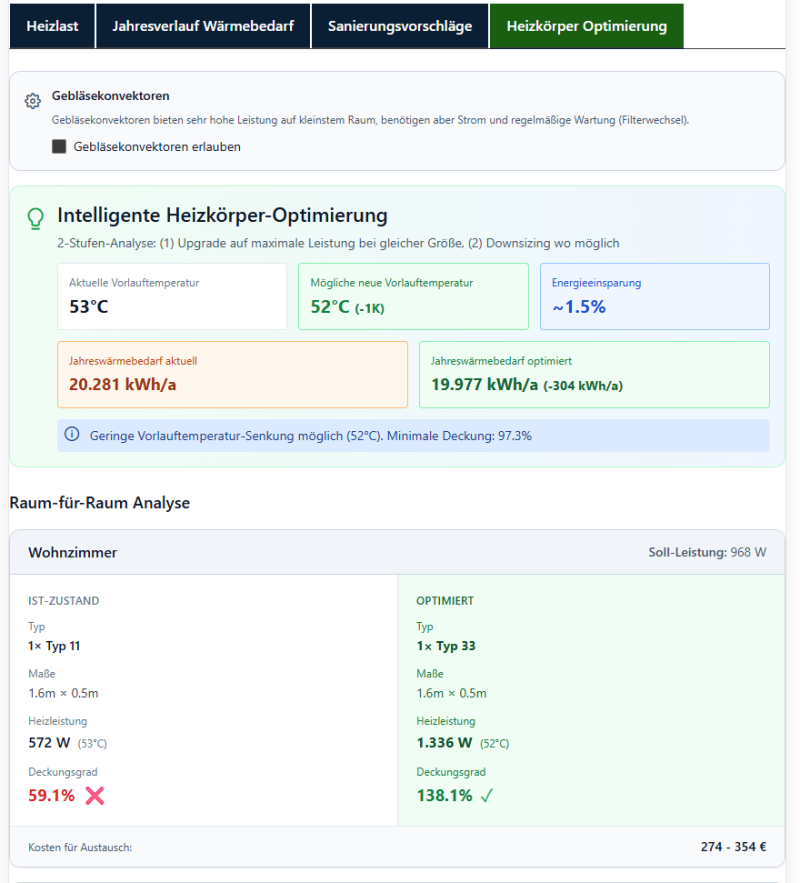 The 2-stage analysis shows specific optimisation suggestions per room
The 2-Stage Analysis
Our algorithm checks two optimisation strategies:
Stage 1: Upgrade to maximum output
- Retaining the current radiator dimensions
- Switching to a higher-output type (e.g. Type 11 → Type 33)
- Minimal installation effort
Stage 2: Downsizing where possible
- With over-provision: Smaller radiator sufficient
- Cost savings on new purchase
- Aesthetic improvement (less bulky radiators)
System-Wide Effects
The analysis shows the effects on the overall system:
| Parameter | Meaning |
|---|---|
| Current flow temperature | Temperature currently required |
| Possible new flow temperature | Achievable after optimisation |
| Energy savings | Percentage savings through lower flow temp |
| Annual heat demand current | Before optimisation |
| Annual heat demand optimised | After optimisation |
Room-by-Room Results
For each room, you receive:
| Information | Description |
|---|---|
| Required output | Required heat output per heating load calculation |
| CURRENT state | Current radiator type and output |
| Coverage rate CURRENT | Current over/under-provision |
| OPTIMISED | Recommended radiator type |
| Coverage rate NEW | After optimisation (always ≥100%) |
| Replacement costs | Rough cost guidance |
Fan Convectors as an Option
For particularly critical rooms with limited space, fan convectors can be activated:
| Property | Advantage | Disadvantage |
|---|---|---|
| High output density | Compact design | Fan electricity consumption |
| Fast response | Short warm-up time | Noise |
| Low flow temp possible | Ideal for heat pump | Regular maintenance |
Practical Optimisation Tips
Step-by-Step Procedure
-
Carry out heating load calculation
- Room-by-room calculation per DIN EN 12831
- Record all rooms
-
Survey existing radiators
- Document type and dimensions
- Determine nominal output (nameplate or manufacturer data)
-
Calculate coverage rate
- For desired flow temperature
- Identify critical rooms
-
Plan optimisation measures
- Prioritise by coverage rate
- Check cost-benefit ratio
-
Carry out hydraulic balancing
- After radiator replacement
- Documentation for BAFA subsidy
Cost Guidance for Radiator Replacement
| Radiator Size | Material | Installation | Total |
|---|---|---|---|
| Small (up to 1000 W) | €150–250 | €100–150 | €250–400 |
| Medium (1000–1500 W) | €250–400 | €120–180 | €370–580 |
| Large (over 1500 W) | €400–700 | €150–220 | €550–920 |
Subsidy Opportunities
Radiator replacement as part of a heat pump installation can be subsidised:
| Subsidy | Rate | Requirement |
|---|---|---|
| BAFA heating optimisation | 15–20% | Hydraulic balancing |
| KfW 458 (with HP) | Up to 70% | New heat pump installation |
| Tax reduction | 20% | Owner-occupation, old building |
Tip: Hydraulic balancing according to Method B (with heating load calculation) is a prerequisite for many subsidy programmes. Our heating load calculation provides all required data!
Special Cases and Alternatives
Retrofitting Underfloor Heating
In some rooms, retrofitting underfloor heating makes sense:
| Situation | Recommendation |
|---|---|
| Bathroom renovation planned | Underfloor heating in bathroom ideal |
| Large living area | Underfloor heating as base load |
| Low ceiling height | Underfloor heating instead of large radiators |
| Allergy sufferers in household | Underfloor heating minimises dust circulation |
Infrared Heating as Supplement
For rarely used rooms, infrared heating can be sensible:
- No water connection needed
- Quick heat on demand
- But: Higher operating costs
High-Temperature Heat Pump
Modern heat pumps can also deliver higher flow temperatures:
| Heat Pump Type | Max. Flow Temperature | Efficiency |
|---|---|---|
| Standard | 55°C | Very good |
| Medium-temperature | 65°C | Good |
| High-temperature | 70–75°C | Satisfactory |
Note: High-temperature heat pumps are more expensive and less efficient. Optimising the radiators is almost always more economical!
Conclusion
Key Point: Radiator optimisation is the key to efficient heat pump operation. By replacing undersized radiators with higher-output types, the flow temperature can often be reduced by 10–15 K – saving up to 30% electricity. Our heating load calculator automatically identifies critical rooms and suggests specific optimisations. Hydraulic balancing according to Method B completes the measure and is a prerequisite for many subsidy programmes.
Try it now: Go to the Heating Load Calculator with Radiator Optimisation
Further Reading
- Understanding Heating Load Results
- Renovation Recommendations from Heating Load Calculation
- Heat Pump Key Figures: COP and SPF
Sources
- DIN EN 12831-1: Heating load calculation
- DIN EN 442: Radiators – Heat output
- VDI 6030: Designing room heating surfaces
- VDI 4645: Planning and dimensioning of heat pump systems