


Renovation Recommendations: Learning from Your Heating Load Calculation
A heating load calculation is more than just a figure for heating system sizing – it is an X-ray of your building. The detailed results show exactly where heat is lost and where renovation measures have the greatest effect. In this article, you will learn how to use this information for targeted renovation planning.
Understanding the Building Envelope
Heat Escapes in Three Ways
| Loss Path | Typical Share | Main Causes |
|---|---|---|
| Transmission | 70–85% | External walls, windows, roof, floor |
| Ventilation | 15–25% | Air exchange, leaks |
| Thermal bridges | 5–15% | Connections, penetrations |
The heating load calculation breaks down these losses in detail – the foundation for any renovation planning.
The U-Value as Key Figure
The thermal transmittance (U-value) describes how much heat escapes through a component:
Q = U × A × ΔT
| Symbol | Meaning | Unit |
|---|---|---|
| Q | Heat loss | Watts (W) |
| U | U-value | W/(m²·K) |
| A | Area | m² |
| ΔT | Temperature difference | Kelvin (K) |
Example: An external wall with U = 1.0 W/(m²·K), 50 m² area and 35 K temperature difference (20°C inside, -15°C outside) loses: Q = 1.0 × 50 × 35 = 1,750 W = 1.75 kW
U-Values of Typical Components
| Component | Unrenovated | After GEG 2024 | Passive House |
|---|---|---|---|
| External wall | 1.0–1.8 | ≤ 0.24 | ≤ 0.15 |
| Roof/top floor ceiling | 0.6–1.2 | ≤ 0.20 | ≤ 0.15 |
| Basement ceiling | 0.8–1.5 | ≤ 0.25 | ≤ 0.15 |
| Windows | 2.5–3.5 | ≤ 1.10 | ≤ 0.80 |
| External door | 2.5–4.0 | ≤ 1.80 | ≤ 0.80 |
Identifying Weak Points
The Heating Load Calculation as Diagnostic Tool
From the component-by-component breakdown, you can directly read:
- Which components cause the highest losses?
- How far do the U-values deviate from the GEG standard?
- Where is the savings potential greatest?
Priorities by Loss Share
| Loss Share | Priority | Typical Components |
|---|---|---|
| > 30% | Very high | External walls (large area) |
| 15–30% | High | Windows, roof |
| 5–15% | Medium | Basement ceiling, doors |
| < 5% | Low | Individual thermal bridges |
Example: Loss Distribution in an Old Building
| Component | Area | U-Value | Loss | Share |
|---|---|---|---|---|
| External wall | 150 m² | 1.2 | 6,300 W | 42% |
| Windows | 30 m² | 2.8 | 2,940 W | 20% |
| Roof | 80 m² | 0.8 | 2,240 W | 15% |
| Basement ceiling | 80 m² | 0.9 | 2,160 W | 14% |
| Ventilation | - | - | 1,350 W | 9% |
| Total | - | - | 15,000 W | 100% |
Renovation Suggestions in the PV-Calor Heating Load Calculator
Our heating load calculator automatically analyses the optimisation potential of each component group based on GEG 2024:
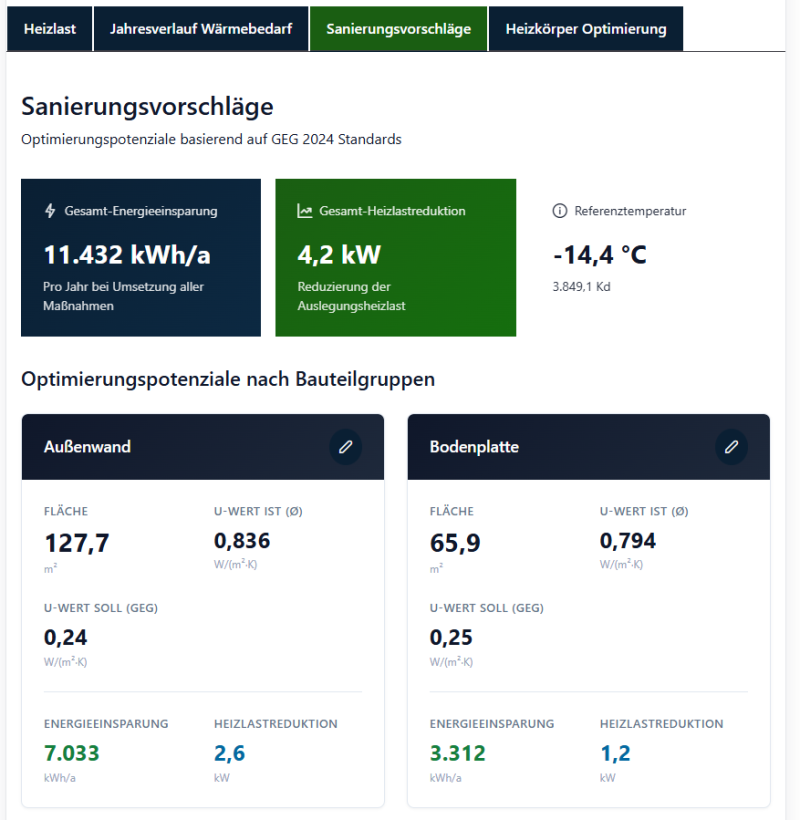 Automatic analysis of savings potential according to GEG standards
The Analysis in Detail
For each component group, the calculator shows:
| Key Figure | Description |
|---|---|
| Area | Total area of the component group |
| U-value ACTUAL (Ø) | Current average U-value |
| U-value TARGET (GEG) | GEG requirement for component renovation |
| Energy savings | Annual savings in kWh/a |
| Heating load reduction | Reduction of design heating load in kW |
Overall Potential
The header summarises the total savings potential:
- Total energy savings: Possible annual savings if all measures are implemented
- Total heating load reduction: Possible reduction of heating load
- Heating degree days (Kd): Climate basis of the calculation
The Most Important Renovation Measures
1. External Wall Insulation
The external wall is often the largest cause of heat losses.
Insulation systems compared:
| System | Insulation Thickness | U-value after | Cost/m² |
|---|---|---|---|
| ETICS (External thermal insulation composite system) | 14–20 cm | 0.18–0.24 | €120–180 |
| Ventilated facade | 16–24 cm | 0.15–0.20 | €180–280 |
| Internal insulation | 6–10 cm | 0.35–0.50 | €80–130 |
| Cavity wall insulation | 4–8 cm | 0.30–0.40 | €25–50 |
Advantages of external wall insulation:
- Highest savings potential (often 25–35% of heating energy)
- Improved living comfort (warm interior walls)
- Protection of building fabric
To consider:
- Plan window connections carefully
- Choose adequate insulation thickness (one-time costs!)
- Check heritage protection and design regulations
Tip: With external wall insulation, generous dimensioning pays off. Labour costs remain the same – only the material becomes more expensive. 20 cm instead of 14 cm costs only ~20% more but provides ~40% better insulation!
2. Roof Insulation / Top Floor Ceiling
Warm air rises – an uninsulated roof is a huge energy waster.
Options:
| Variant | Application | U-value | Cost |
|---|---|---|---|
| Between-rafter insulation | Occupied attic | 0.18–0.24 | €50–80/m² |
| Above-rafter insulation | During roof renovation | 0.14–0.18 | €150–250/m² |
| Top floor ceiling insulation | Unheated attic | 0.14–0.20 | €30–60/m² |
Special case top floor ceiling:
- Cheapest measure with very high benefit
- Often feasible as DIY project
- Mandatory under GEG upon change of ownership
3. Basement Ceiling Insulation
Cold feet on the ground floor? The basement ceiling is often the culprit.
| Variant | Insulation Thickness | U-value | Cost |
|---|---|---|---|
| Underside insulation | 8–12 cm | 0.25–0.30 | €35–55/m² |
| Topside insulation | 3–6 cm | 0.40–0.50 | €50–90/m² |
Advantages:
- Easy implementation with accessible basement ceiling
- Noticeable comfort improvement (warm feet!)
- Relatively inexpensive
4. Window Replacement
Old windows are often the largest individual weak points:
| Window Type | Uw-Value | g-Value | Cost |
|---|---|---|---|
| Single glazing | 5.0–5.5 | 0.85 | - |
| Double glazing (old) | 2.5–3.0 | 0.75 | - |
| Double low-e | 1.1–1.3 | 0.60 | €300–450/m² |
| Triple low-e | 0.6–0.9 | 0.50 | €400–600/m² |
Important when replacing windows:
- Consider g-value (solar gains)
- Account for frame proportion and installation situation
- Consider facade insulation at the same time
5. Airtightness and Thermal Bridges
Often underestimated, but important:
| Measure | Savings Potential | Cost |
|---|---|---|
| Roller shutter box insulation | 1–3% | €50–150/unit |
| Window/door sealing | 1–2% | €10–30/window |
| Radiator niche insulation | 0.5–1% | €30–60/niche |
| Pipe insulation | 2–5% | €10–20/m |
Economic Viability and Prioritisation
Cost-Benefit Ratio
| Measure | Savings | Cost | Payback |
|---|---|---|---|
| Top floor ceiling insulation | 10–15% | €30–60/m² | 3–6 years |
| Basement ceiling insulation | 5–10% | €35–55/m² | 5–8 years |
| External wall insulation | 20–35% | €120–180/m² | 12–20 years |
| Window replacement | 10–15% | €400–600/m² | 15–25 years |
| Roof insulation | 15–25% | €100–200/m² | 10–15 years |
Prioritisation Matrix
| Criterion | Highest Priority | Medium Priority | Low Priority |
|---|---|---|---|
| Savings potential | > 20% | 10–20% | < 10% |
| Payback | < 8 years | 8–15 years | > 15 years |
| Comfort improvement | High | Medium | Low |
| Due anyway | Yes | Partly | No |
The Right Sequence
Recommended renovation sequence:
-
Top floor ceiling / Roof
- Inexpensive, high impact, fast payback
-
Basement ceiling
- Inexpensive, noticeable comfort improvement
-
External wall + Windows (together!)
- Greatest potential, but expensive
- Only sensible when facade renovation is planned anyway
-
Ventilation system
- Important after improving airtightness
- Heat recovery saves additional energy
Golden rule: "First the envelope, then the technology!" Renovate the building envelope first, then the heating system. An optimally insulated building envelope needs a much smaller (and cheaper) heating system.
GEG Requirements for Renovation
Conditional Requirements
The GEG 2024 only prescribes U-values when you renovate anyway:
| Component | Required U-value | Trigger |
|---|---|---|
| External wall | ≤ 0.24 W/(m²·K) | Renewal of > 10% of area |
| Roof | ≤ 0.20 W/(m²·K) | Renewal of roof covering |
| Top floor ceiling | ≤ 0.24 W/(m²·K) | Mandatory upon change of ownership |
| Windows | ≤ 1.10 W/(m²·K) | Window replacement |
| External door | ≤ 1.80 W/(m²·K) | Door replacement |
Exceptions
- Listed buildings
- Economic non-viability (to be proven case by case)
- Technical impossibility
Subsidy Opportunities 2025
Federal Funding for Efficient Buildings (BEG)
| Measure | Subsidy Rate | Max. Subsidy Amount |
|---|---|---|
| Individual envelope measures | 15% | €30,000/dwelling |
| + iSFP bonus | +5% | - |
| Heating replacement (HP) | 30–70% | €30,000/dwelling |
| Complete renovation EH | 5–25% | €150,000/dwelling |
Tax Incentive
| Variant | Rate | Period |
|---|---|---|
| § 35c EStG | 20% | Spread over 3 years |
Important Prerequisites
- Involve energy efficiency expert (for BEG)
- Submit application before starting the measure
- Meet technical minimum requirements
- Engage qualified contractors
Tip: The individual renovation roadmap (iSFP) not only brings 5% extra subsidy but also a structured plan for step-by-step renovation. The cost of the iSFP is 80% subsidised!
From Calculation to Implementation
Step-by-Step Approach
-
Carry out heating load calculation
- Component-by-component analysis
- Document U-values
-
Identify weak points
- Components with highest losses
- Deviation from GEG values
-
Create renovation roadmap
- Prioritise measures
- Plan timing
-
Check economic viability
- Determine costs
- Factor in subsidies
- Calculate payback
-
Apply for subsidies
- Involve energy consultant
- Submit applications
-
Implementation
- Engage specialist contractors
- Quality control
After Renovation
- New heating load calculation
- Adjust heating system (often smaller possible)
- New hydraulic balancing
- Monitor success (consumption monitoring)
Conclusion
Key Point: The heating load calculation is the perfect tool for identifying renovation priorities. It shows exactly which components cause the greatest heat losses and where investments yield the highest returns. The rule of thumb: first the cheapest measures with fast payback (top floor ceiling, basement ceiling), then the more complex measures when maintenance is due anyway (facade, windows). With current subsidy programmes, many measures become significantly more economical.
Determine your potential now: Go to the Heating Load Calculator with Renovation Analysis
Further Reading
- Understanding Heating Load Results
- Radiator Optimisation for Heat Pumps
- Guide to Heating Load Calculation
Sources
- Building Energy Act (GEG) 2024
- DIN EN 12831-1: Heating load calculation
- DIN 4108: Thermal insulation in buildings
- BAFA: Federal funding for efficient buildings
- dena: Renovation roadmap for residential buildings