


Optimize Self-Consumption: Use More of Your Solar Power
A typical 10 kWp system generates around 10,000 kWh of electricity per year. Without targeted measures, the household only uses 25–35 % of this. The grid absorbs the rest at 7.78 cents per kilowatt-hour. Every kilowatt-hour consumed on-site, however, replaces grid electricity at 35 cents – a difference of 27 cents per kilowatt-hour that adds up to tens of thousands of euros over the lifetime of a PV system.
This article explains what self-consumption and self-sufficiency mean, why self-consumption has become the decisive economic factor, and which five strategies can raise it from 25 to over 80 percent.
Self-consumption and self-sufficiency – two metrics, one goal
In practice, two metrics are used that are often confused. They describe different perspectives on the same matter.
The self-consumption rate indicates what share of the generated solar power is used directly in the household:
Self-consumption rate (%) = Self-consumption ÷ PV generation × 100
The self-sufficiency rate looks at the other side: What share of the electricity demand is covered by the PV system?
Self-sufficiency rate (%) = Self-consumption ÷ Total electricity consumption × 100
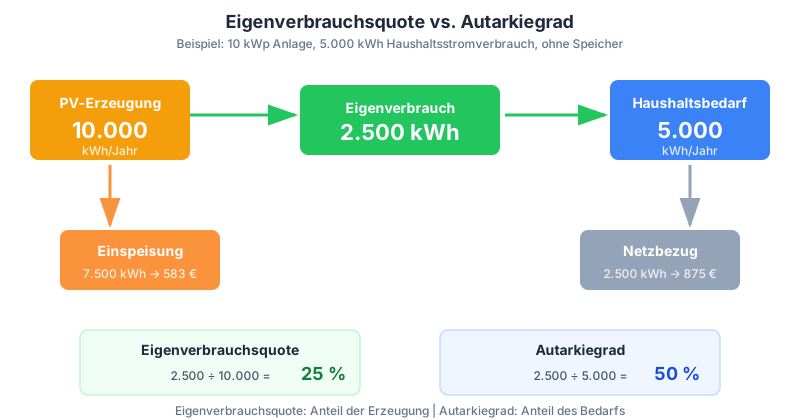
An example illustrates the difference. A 10 kWp system generates 10,000 kWh per year. The household consumes a total of 5,000 kWh, of which 2,500 kWh come directly from the PV system. The self-consumption rate is 2,500 ÷ 10,000 = 25 %. The self-sufficiency rate is 2,500 ÷ 5,000 = 50 %. The household thus covers half of its demand with solar, but only uses a quarter of the generation itself.
The relationship between the two metrics is inverse: A very large system has a low self-consumption rate (lots of surplus) but a high self-sufficiency rate (large share of demand covered). A small system has a high self-consumption rate (almost everything is used) but a low self-sufficiency rate (the household still draws a lot of grid power). Ultimately, the absolute self-consumption in kilowatt-hours determines the economic outcome – not the percentage rate.
The economic logic – why every self-consumed kilowatt-hour counts
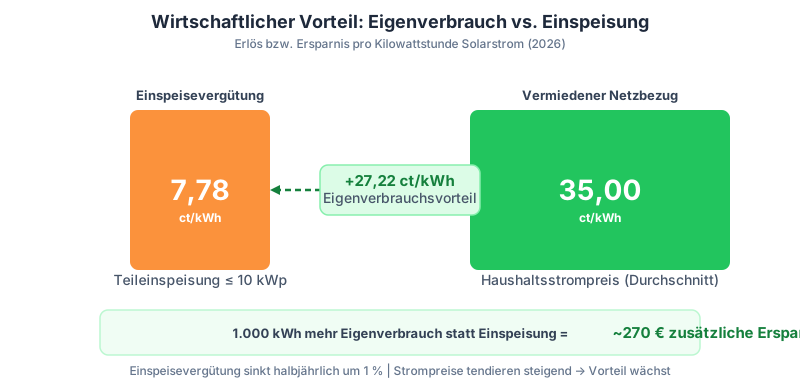
The feed-in tariff for partial feed-in has been at 7.78 ct/kWh since February 2026 (systems ≤ 10 kWp) and decreases by 1 % every six months. The household electricity price, meanwhile, is around 35–40 ct/kWh. The difference of roughly 27 cents per kilowatt-hour is the economic core of self-consumption optimization: anyone who uses a kilowatt-hour of solar power themselves instead of feeding it in saves the difference between avoided grid purchase and foregone feed-in tariff.
| Year | Feed-in tariff | Household electricity price | Self-consumption advantage |
|---|---|---|---|
| 2024 | 8.11 ct/kWh | ~32 ct/kWh | ~24 ct/kWh |
| 2026 | 7.78 ct/kWh | ~35 ct/kWh | ~27 ct/kWh |
| 2028 (forecast) | ~7.0 ct/kWh | ~37 ct/kWh | ~30 ct/kWh |
The trend is clear: the gap between declining feed-in tariffs and rising electricity prices continues to widen. For anyone installing a system in 2026, self-consumption is already the most important economic factor today – and it will become even more so in every subsequent year.
Calculation example: The levelized cost of PV electricity is 6–12 ct/kWh. Every self-consumed kilowatt-hour yields a gain of 23–29 ct compared to grid purchase. 1,000 kWh more self-consumption instead of feed-in means approximately 270 EUR in additional savings per year.
Typical self-consumption – what remains without optimization
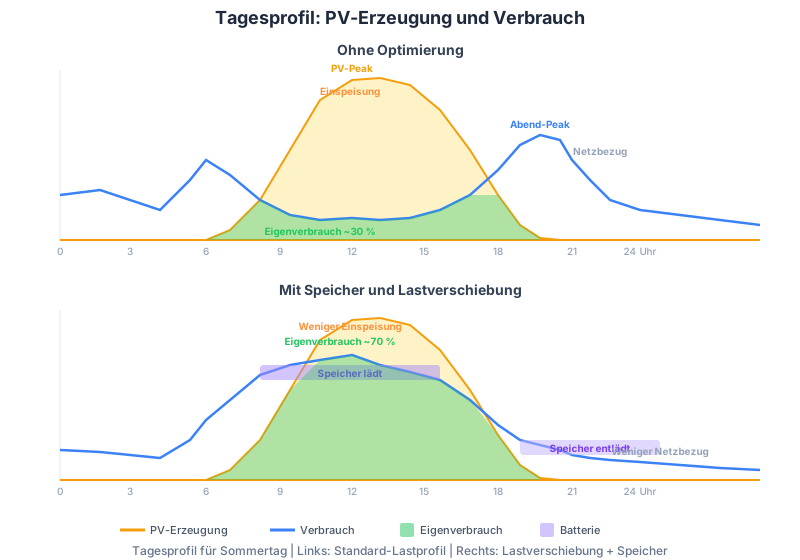
The fundamental problem of every PV system is the time gap between generation and consumption. The solar system produces most of its electricity between 10 AM and 3 PM. The household, however, consumes the most in the morning at breakfast and in the evening after work. At midday – when generation peaks – nobody is often home. The result: surplus flows into the grid, and expensive grid power is drawn in the evening.
Without any optimization measures, typical self-consumption rates are 20 to 35 percent, depending on system size and consumption:
| System size | Household electricity | Self-consumption rate | Self-sufficiency rate |
|---|---|---|---|
| 5 kWp | 3,500 kWh/a | 30–35 % | 40–50 % |
| 8 kWp | 4,500 kWh/a | 25–30 % | 40–50 % |
| 10 kWp | 5,000 kWh/a | 20–28 % | 35–45 % |
| 15 kWp | 5,000 kWh/a | 15–22 % | 35–50 % |
Two patterns stand out. First: the larger the system relative to consumption, the lower the self-consumption rate – but the higher the absolute self-consumption and the self-sufficiency rate. Second: the seasonal effect is substantial. In summer, the system generates three to four times the winter yield, while electricity consumption remains relatively constant. The self-consumption rate can be 15 % in June and 80 % in December – the annual average is what matters.
The five strategies for self-consumption optimization
The good news: there are five proven strategies that individually or in combination significantly increase self-consumption. Each has different investment costs, effectiveness and prerequisites.
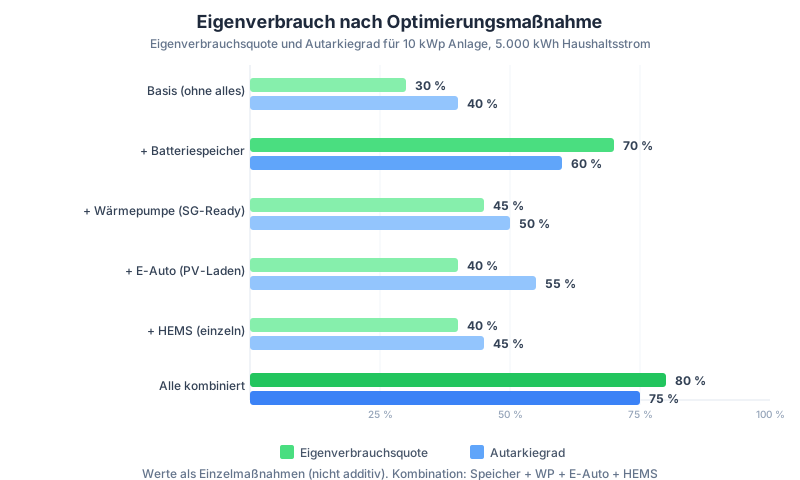
| Measure | Self-consumption rate | Self-sufficiency rate | Investment |
|---|---|---|---|
| Baseline (nothing) | 25–35 % | 35–45 % | — |
| + Battery storage | 60–80 % | 50–70 % | 4,000–10,000 EUR |
| + Heat pump (SG-Ready) | 40–55 % | 40–55 % | usually planned anyway |
| + EV (PV charging) | 35–50 % | 45–60 % | Wallbox 500–2,000 EUR |
| + HEMS | +5–10 % additional | +5–10 % | 500–2,000 EUR |
| Combination of all strategies | 70–85 % | 60–80 % | system-dependent |
The values apply as individual measures (not additive). When combined, the effects overlap and the total effect is higher than any single measure but lower than the sum of all individual effects. The following sections examine each strategy in detail.
Battery storage – the single most important lever
How a battery increases self-consumption
A battery storage system solves the timing problem of photovoltaics. It absorbs the midday surplus and releases it in the evening and at night when the household needs electricity. The effect is considerable: a properly sized battery typically raises the self-consumption rate from 25–35 % to 60–80 %.
The right storage size
Two rules of thumb have proven effective for sizing, both leading to the same result:
- 1 kWh usable capacity per 1 kWp system capacity
- 1 kWh per 1,000 kWh annual electricity consumption
For a 10 kWp system with 5,000 kWh annual consumption, a storage capacity of 8–10 kWh is recommended. Specifically by household size:
| Household size | Electricity consumption | PV capacity | Storage |
|---|---|---|---|
| 1–2 persons | 2,500–3,500 kWh | 5–7 kWp | 5–7 kWh |
| 3–4 persons | 4,000–5,500 kWh | 8–10 kWp | 8–10 kWh |
| 5+ persons or with heat pump | 6,000–10,000 kWh | 10–15 kWp | 10–15 kWh |
Economic viability of storage
The levelized cost of stored electricity is 15–25 ct/kWh, depending on purchase price, usable capacity and number of charge cycles over the lifetime. As long as these costs are below the household electricity price (currently 35–40 ct/kWh), the storage system is economically viable. The payback period is 10–15 years with a lifespan of 15–20 years.
However, a battery pays for itself more slowly than the PV system itself (8–12 years). This is because the battery does not generate energy but only shifts it in time. It earns on the difference between the feed-in tariff (7.78 ct) and avoided grid purchase (35 ct) – roughly 27 ct per stored kWh. With 250 full cycles per year and 10 kWh capacity, that amounts to 675 EUR in savings per year.
Practical tip: Oversized batteries are uneconomical – the last 20 % of capacity is rarely used in everyday life. The battery should be able to cover a typical evening and night consumption, not the consumption of several days. Slightly undersizing leads to shorter payback periods.
Heat pump as thermal storage
Anyone operating or planning a heat pump has a natural ally in self-consumption optimization. The basic idea: the heat pump preferably runs when the PV system is generating electricity and stores the energy as heat in the buffer or hot water tank. Unlike a battery, no electrical energy is stored but thermal energy – with the advantage that every household with a heat pump already has the necessary heat storage.
The self-consumption rate typically increases from 30 % to 40–55 % with a PV-coupled heat pump, depending on heat demand and storage volume.
Practical implementation
Most modern heat pumps have an SG-Ready interface (Smart Grid Ready). Via two potential-free contacts, the heat pump receives a signal from the inverter or HEMS that PV surplus is available. The heat pump responds with increased operation:
- Hot water tank is heated to 55–60 °C instead of the usual 48 °C
- Buffer tank is charged 2–3 K above the setpoint
- Underfloor heating can absorb thermal energy as a surface storage
In practice, this means 1,000–2,000 kWh of additional self-consumption per year. The investment is limited to wiring the SG-Ready contacts and possibly a control unit – the heat pump and heat storage are already in place.
Sizing: additional PV for heat pump
Anyone operating a heat pump and still planning or expanding the PV system should account for the additional electricity demand. The rule of thumb: 2–3 kWp additional PV capacity per kW of thermal heating output. A heat pump with 10 kW heating output and SCOP 3.5 consumes approximately 2,857 kWh of electricity per year – 3–4 kWp of additional PV capacity makes sense for this.
Detailed information on the PV-heat pump combination can be found in the article Heat pump types and the dream team with solar. The calculation of heat pump electricity consumption is explained in Heat pump electricity consumption per year.
Load shifting in everyday life – smart consumption
Move large consumers to midday
The simplest and cost-free measure for increasing self-consumption is the deliberate shifting of power-intensive activities to midday, when the PV system produces the most.
The largest individual consumers in the household and their shifting potential:
| Appliance | Consumption per cycle | Runtime | Optimal start time |
|---|---|---|---|
| Washing machine | 1.5–2.5 kWh | 1.5–2 h | 11:00 AM |
| Tumble dryer | 2.5–4.0 kWh | 1.5–2.5 h | 1:00 PM |
| Dishwasher | 1.0–1.5 kWh | 1.5–2 h | 12:00 PM |
| Pool pump | 0.5–1.5 kW (continuous) | 4–8 h | 10:00 AM |
Through conscious timing alone, an additional 500–1,000 kWh per year can be self-consumed – at zero investment. Many appliances have a timer function that schedules the start for midday. Those working from home have it particularly easy.
Home Energy Management System (HEMS)
A HEMS automates load shifting. It monitors generation, consumption and storage level in real time and controls consumers automatically based on PV surplus and weather forecasts. Typical control functions: battery storage management, heat pump activation on surplus, wallbox control and smart appliance scheduling.
The additional effect of a HEMS is 5–10 percentage points of self-consumption compared to manual control. Costs range from 500 to 2,000 EUR, with many modern hybrid inverters already having a basic HEMS integrated.
Dynamic electricity tariffs
Since 2025, all electricity suppliers must offer dynamic tariffs. For PV owners with a smart meter, this opens up additional optimization possibilities: when exchange prices are negative – which occurs more frequently in 2025 and 2026 – it can be cheaper to draw grid power and charge the battery with it rather than storing PV power. This strategy complements self-consumption optimization but does not replace it: the principle "self-consume before feeding in" remains the most important economic lever.
EV and wallbox – the flexible large consumer
An electric vehicle, with 2,000–4,000 kWh annual consumption, is the largest flexible consumer in many households. Anyone who can charge it at the home wallbox during the day shifts a significant portion of this demand into PV generation hours.
PV surplus-controlled charging works as follows: the wallbox starts the charging process only when the PV system produces more than the household consumes. With single-phase charging (1.4 kW minimum power), even a small surplus is sufficient. Three-phase charging (at least 4.1 kW) requires more surplus and is better suited for larger systems from 8–10 kWp.
The effect on the self-consumption rate is +10–20 percentage points if the car is regularly at home during the day. With 15,000 km annual mileage and a consumption of 18 kWh/100 km, the car needs 2,700 kWh per year. Of this, 1,500–2,000 kWh can be covered through PV surplus charging.
Bidirectional charging (Vehicle-to-Home)
The next level is Vehicle-to-Home (V2H): the EV returns electricity to the household in the evening, functioning like a battery storage system with 50–80 kWh capacity. The technology is available in first production vehicles and wallboxes in 2026 but has not yet reached the mass market. For the future, V2H offers enormous potential – anyone installing a bidirectional-capable wallbox today is prepared.
Home office advantage: Anyone working from home during the day with the EV regularly parked at the wallbox benefits doubly. Five hours of PV charging at 3.5 kW surplus deliver 17.5 kWh – enough for approximately 100 kilometers of range, every day.
Three practical examples calculated
Example 1 – Small household without storage
Starting situation: 2-person household, existing building, 5 kWp system, no storage, no EV, gas heating.
| Parameter | Value |
|---|---|
| Electricity consumption | 3,000 kWh/a |
| PV generation | 5,000 kWh/a |
| Self-consumption | 1,500 kWh (30 %) |
| Self-sufficiency rate | 50 % |
| Feed-in | 3,500 kWh × 0.0778 EUR = 272 EUR |
| Avoided grid purchase | 1,500 kWh × 0.35 EUR = 525 EUR |
| Total savings | 797 EUR/a |
Even without storage, the system saves nearly 800 EUR per year. The remaining 1,500 kWh of grid purchase costs 525 EUR – a battery could eliminate the bulk of this.
Example 2 – Family with storage and heat pump
Starting situation: 4-person household, KfW-55 new build, 10 kWp + 10 kWh storage, air-to-water heat pump with SG-Ready.
| Parameter | Value |
|---|---|
| Household electricity | 4,500 kWh/a |
| Heat pump electricity | 3,000 kWh/a |
| Total consumption | 7,500 kWh/a |
| PV generation | 10,000 kWh/a |
| Self-consumption | 6,500 kWh (65 %) |
| Self-sufficiency rate | 87 % |
| Feed-in | 3,500 kWh × 0.0778 EUR = 272 EUR |
| Avoided grid purchase | 6,500 kWh × 0.35 EUR = 2,275 EUR |
| Total savings | 2,547 EUR/a |
The combination of storage and SG-Ready heat pump brings self-consumption to 65 %. The household draws only 1,000 kWh from the grid (350 EUR/a electricity costs). The annual savings of over 2,500 EUR pay off the PV system in 5–7 years.
Example 3 – Fully optimized system with EV
Starting situation: 4-person household, 15 kWp + 15 kWh storage, heat pump, EV (15,000 km/a), HEMS.
| Parameter | Value |
|---|---|
| Household electricity | 4,500 kWh/a |
| Heat pump electricity | 3,000 kWh/a |
| EV | 3,000 kWh/a |
| Total consumption | 10,500 kWh/a |
| PV generation | 15,000 kWh/a |
| Self-consumption | 11,250 kWh (75 %) |
| Self-sufficiency rate | ~80 % (seasonally adjusted) |
| Feed-in | 3,750 kWh × 0.0778 EUR = 292 EUR |
| Avoided grid purchase | 11,250 kWh × 0.35 EUR = 3,938 EUR |
| Total savings | 4,230 EUR/a |
The fully optimized system achieves over 4,200 EUR in annual savings. The theoretical self-sufficiency rate of over 100 % (generation > consumption) is moderated by seasonal effects: in winter, PV generation is insufficient for full demand; in summer, significant surplus occurs. The effective self-sufficiency rate is approximately 80 %.
Common mistakes in self-consumption optimization
Several misconceptions appear regularly in practice and lead to suboptimal investment decisions.
The most common mistake is a PV system that is too small. Anyone already operating a heat pump or planning an electric vehicle should size the system generously from the start. The marginal cost per additional kWp decreases with system size, and retrofitting is more expensive than planning correctly from the outset.
Conversely, an oversized battery storage leads to poor economics. The last 20 % of storage capacity is rarely used in everyday life – the battery is only fully charged and discharged in ideal weather conditions. A battery that can cover the average evening and night consumption (not peak consumption) is economically optimal.
Another mistake is focusing exclusively on the self-consumption rate. A rate of 90 % sounds good but may mean the system is too small and the household still draws significant grid power. The self-sufficiency rate and the absolute self-consumption in kWh are more meaningful for actual cost savings.
Finally, seasonal fluctuation is underestimated. In summer, self-consumption can be at 15 % (lots of sun, low consumption); in winter, at 80 % (little sun, high consumption from heat pump). Optimization measures should therefore target summer – in winter, self-consumption is already high.
Frequently asked questions
What is a good self-consumption rate for a photovoltaic system?
Without storage, 30–35 % is typical. With battery storage and smart controls, 60–80 % is achievable. The absolute self-consumption in kWh is more important than the rate: 4,000 kWh self-consumption at 30 % rate (large system) is economically better than 2,000 kWh at 60 % rate (small system).
How do I increase my self-consumption without battery storage?
Through deliberate load shifting: schedule the washing machine, dryer and dishwasher for midday. Run the heat pump and hot water preparation preferably during the day. Charge the EV during the day. These measures alone can increase self-consumption by 5–15 percentage points.
Is a battery storage system worthwhile for self-consumption?
Economically yes, if the levelized cost of stored electricity (15–25 ct/kWh) is below the household electricity price – which is currently the case. Payback takes 10–15 years. A battery is particularly worthwhile with high evening and night consumption and when no heat pump tariff (27 ct) is used.
How much self-consumption is possible with a heat pump?
A heat pump with SG-Ready integration typically increases self-consumption by 10–20 percentage points. In combination with a battery storage system, self-consumption rates of 65–80 % are realistic. The effect is greatest during transitional seasons (spring/autumn), when both heating demand and solar yield are present.
Do I need a HEMS for self-consumption optimization?
A HEMS is not strictly necessary but adds 5–10 percentage points of additional self-consumption through automated control. It is particularly worthwhile for complex systems with storage, heat pump and wallbox because it factors in weather forecasts and consumption patterns. Many hybrid inverters already have a basic HEMS integrated.
Can I achieve 100 % self-sufficiency with self-consumption?
In practice, no. In winter, PV generation in Germany is insufficient for the full demand of a heated household. Even with a very large system, storage and heat pump, the realistic annual self-sufficiency rate is 70–85 %. The last few percentage points require disproportionately high investments and are not economically sensible.
Conclusion
The essentials: In 2026, self-consumption is the decisive economic factor for every PV system. While the feed-in tariff has dropped below 8 cents, every self-consumed kilowatt-hour saves approximately 27 cents compared to grid purchase. Battery storage delivers the greatest effect as a single measure, doubling self-consumption to 60–80 %. Additionally integrating a heat pump via the SG-Ready interface and charging the EV during the day achieves self-consumption rates of 70–85 % and savings of over 4,000 euros per year. The simplest measure – shifting large consumers to midday – costs nothing and adds 500 to 1,000 kWh of additional self-consumption.
The planning of a PV system should always start from self-consumption: Which consumers are flexible? Which storage fits the consumption profile? Which future loads (heat pump, EV) should already be planned for today? Anyone who clarifies these questions upfront gets significantly more out of their solar system than with pure yield maximization.
The fundamentals of yield calculation are explained in the article Calculate PV yield: factors and formulas. For optimal planning of your system, we recommend Plan a solar system: step by step. How heat pump and PV work together is described in Heat pump types and the dream team with solar. Everything about battery storage can be found in our Battery storage overview.
Calculate your self-consumption and economics now
With our Solar Calculator, you can calculate the expected PV yield, the optimal self-consumption rate and the economics of your system – including storage and heat pump.